Through their eyes: Interview with the author of a picture book on Down Syndrome

Hey there. Today, I have the absolute pleasure of chatting with a powerhouse mother who has written a heartwarming picture book, Jana’s brightly coloured socks, pouring her heart and soul into raising awareness about Down syndrome.

You know, as an author we’re always told to “write what you know,” and Sally’s personal experience is what makes this book special. So over to Sally Fetouh for the inspiring story behind her book.

Two years ago, I visited my daughter’s preschool to read a book about Down syndrome to her classroom, as a way to celebrate World Down Syndrome Day. Little did I know that the whole experience would spark the idea for my picture book, which is based on my daughter, Jana, who has Down syndrome. 

Jana’s Brightly Coloured Socks’ is a story that celebrates friendship, differences, inclusivity, acceptance, and kindness, all emphasising the importance of having a sense of fun. When young Jana learns a new milestone – how to put on her socks on her own – her parents gift her a drawer full of brightly coloured socks. She wears them everywhere she goes, and when she shows her favourite pair to her friends at school, everyone wants a pair too. Jana gets an idea of sharing a pair with one of her friends every day until she has none left. This calls for a sock parade at school, that culminates with a beautiful surprise of a big box filled with balloons and socks just for Jana, gifted to her by her school friends. The message at the end in the midst of the carnival-like atmosphere is that it is okay to be different because that is what makes the world a fun and fantastic place to be.

Jana’s condition and diagnosis came as a complete surprise to us at birth. Down syndrome is a condition that happens at conception when an extra chromosome forms in the 21st chromosome in every cell in the baby’s body. There is no rhyme or reason to it and no one knows why this happens, but it is a naturally occurring phenomenon that has occurred for thousands of years. I read a post on social media recently that likened the condition to a four-leaf clover that is found in nature amongst other three-leaf clovers. No one knows why these four-leaf clovers exist, but some people consider them lucky! In a way that is how we think of Jana. We are lucky to have her in our lives. We had not had much exposure into the world of disabilities before Jana was born. There was much fear and ignorance at the time for us. We did not know what to expect nor what it all meant. We feared how society and the community would receive her, apprehensive about what school would be like for her. Six years later, we cannot imagine life being any other way, despite the challenges. The positives far outweigh any of the fears, most of which we found to be baseless.

Thinking back to that day when I visited the preschool, I remember the children being so engaged, interested, and curious. My heart was overflowing with emotion when I left, and that feeling stayed with me for days after. I was extremely touched by how open the children were, not just to something they knew nothing about in the condition called Down syndrome, but mostly to how they saw my daughter as a person. They saw past her label, past her diagnosis, and were genuinely trying to understand why she was a little different to them. They wanted to know how to be her friend. It was like a warm embrace, and a ray of hope for the future. 

There were several factors that motivated me to write the story. One was to provide a snapshot into what living with Down syndrome is like, showcasing the fun, quirky and carefree elements. I wanted children with Down syndrome to be able to see themselves represented in literature, but Down syndrome was deliberately not explicitly mentioned in the story to allow for anyone, whether they have a disability or not, to connect with the character. The message is that it is okay to be different and that all children want is to be treated the same as their peers, to have friends, learn and have fun. Finally, I wanted to convey a positive experience in the importance of celebrating milestones and achievements, no matter how small, because despite the nature of the journey, there is always something to celebrate.

Blurb

Cheerful text and whimsical illustrations bring alive this heart-warming story of kindness and inclusion featuring a character with Down syndrome.

When young Jana receives heaps of beautiful socks from her parents after learning how to put on socks all by herself, she can’t wait to show her friends at school. They are always kind and patient with Jana when they play together. Jana decides to share a pair of her new socks with each and every friend. This calls for a school sock parade! All of the children had so much fun showing off their colourful socks together that they gave a very special and huge gift for their kind and generous friend, Jana, a box of more socks!

Author Sally Fetouh was inspired to write this touching story by her own daughter who has Down syndrome, feeling it was important for her and other children like her to be able to see themselves in literature. Two years ago, after reading a different story about a girl with Down syndrome to her daughter’s preschool class, Sally says, “The children were so engaged in the story and asked questions. They were very accepting and loving of their friend—my daughter. I left with a heart overflowing with emotion and that inspired me to write my story.”

About the author

Writing is very much a part of who author Sally Fetouh is as a human being. As a child, writing was a way for her to express herself and all of the stories and ideas she had in her head. Now, as an adult, she has been inspired to write a beautiful story of kindness and friendship, Jana’s Brightly Coloured Socks, a heart-warming picture book loosely based on her daughter who has Down syndrome.

It was important to Sally that her daughter and other children like her were able to see themselves represented in literature. The idea came to Sally when she visited her daughter’s preschool to read a story about a girl with Down syndrome. The loving, accepting, and inquisitive responses from her daughter’s classmates inspired her to write a story reflecting these caring friendships.

Sally believes a great book is one that has impactful characters and a story that provides a new experience or perspective to the reader that stays with them long after the book is closed. She hopes that her young readers with disabilities or those who are different in some way will be able to relate to the main character and see a little bit of themselves, while also aiming for other readers to gain insight into the world of Down syndrome and the importance and impact of kindness and friendship. 

When she isn’t writing thought-provoking children’s books, Sally works as a lawyer and a photographer. She enjoys being in nature, hiking, and horse riding. She lives with her family in Sydney, Australia. Jana’s Brightly Coloured Socks is her debut picture book.

Conservation Superstars: Unveiling the Secret Lives of Wildlife Guardians and Their Amazing Careers

I’m so excited to be part of the book tour for “Caring Conservationists who are changing our planet” by Kate Peridot, and richly illustrated by Sarah Long. There’s a super mix of conservationists featured from the obvious (Sir David Attenborough), and I’m embarrassed to say I had not heard of most of them myself so found it really interesting. Great mix of info on the people, facts, and simple activities. I actually think there’s a great angle here to discuss career options as well as the animal aspects.

Extension activities for parents/ teachers

For fun, I thought I’d ask ChatGPT to give me some ideas for extension activities as the activities included in the book are fairly simple. Here’s what it suggested (unedited):

  • Wildlife Detective: Solve the Conservation Mystery!” – Frame the blog as a thrilling detective adventure where children must solve a conservation mystery. Introduce different conservation careers, such as wildlife biologist, park ranger, or marine biologist, and present clues and challenges for children to uncover the solution.
  • Conservation Champions: Create Your Dream Team!” – Encourage children to assemble their own dream team of conservationists. Provide descriptions of different conservation careers and ask children to choose team members with complementary skills. They can design their team’s logo, create backstories, and imagine exciting conservation missions.
  • Conservation Safari: Explore the World of Wildlife Careers!” – Take children on a virtual safari to explore various wildlife careers. Each stop on the safari can introduce a different career, such as animal trainer, wildlife photographer, or animal behaviorist. Provide interactive quizzes or games to help children discover which career suits them best.
  • Animal Rescue Challenge: Become a Wildlife Hero!” – Present a series of animal rescue scenarios and challenge children to think like wildlife rehabilitators. Provide information about the animals in need and ask children to come up with creative solutions to rescue and care for them. Encourage them to share their ideas and discuss the importance of teamwork in conservation efforts.
  • Conservation Art Show: Express Your Love for Nature!” – Highlight the role of artists in conservation and encourage children to unleash their creativity. Ask them to create artwork, such as paintings, sculptures, or digital illustrations, inspired by nature and endangered species. They can share their artwork with family and friends and discuss the importance of art in raising awareness about conservation.
  • Animal Planet Interview: Meet Real-Life Conservation Heroes!” – Conduct imaginary interviews with renowned conservationists, presenting them as guests on a talk show. Children can come up with their own interview questions and learn about the experiences, motivations, and challenges of these inspiring conservation heroes.

What do you think? I actually think ChatGPT has done a pretty good job of coming up with extension activities suitable for a range of ages, and if it was my book (and I really wish it was as it’s fab), I’d be doing a downloadable class pack building on some of these.

Blurb

Travel around the world and discover the stories of 20 conservationists and the endangered animals they are helping to save, including the orangutang, blue whale, Indian tiger, rhino, honeybee, Komodo dragon and sea turtle. Positive, uplifting and packed full of information, with 20 fun activities for children to try, this book will show children no one is too small to make a difference.

Author bio

Kate is an author of both fiction and non-fiction children’s books. Originally from London, she now lives with her family in the South of France. She writes wild and adventurous stories about animals, people and STEM that encourages a can-do spirit, a quest for knowledge and a sense of adventure. Caring Conservationists (Walker Books) is her first non-fiction children’s books. A further nine books are in production launching between 2023-2025. 

Queen Bees, and a tribute

Oh my, I love this book! Why? Before I start, here are two random facts about me.

  1. I have planted a wildflower “meadow” (aka patch).
  2. I am signed up for a beekeeping course in 2023. I’m terrified of getting stung, so we’ll see how it goes!

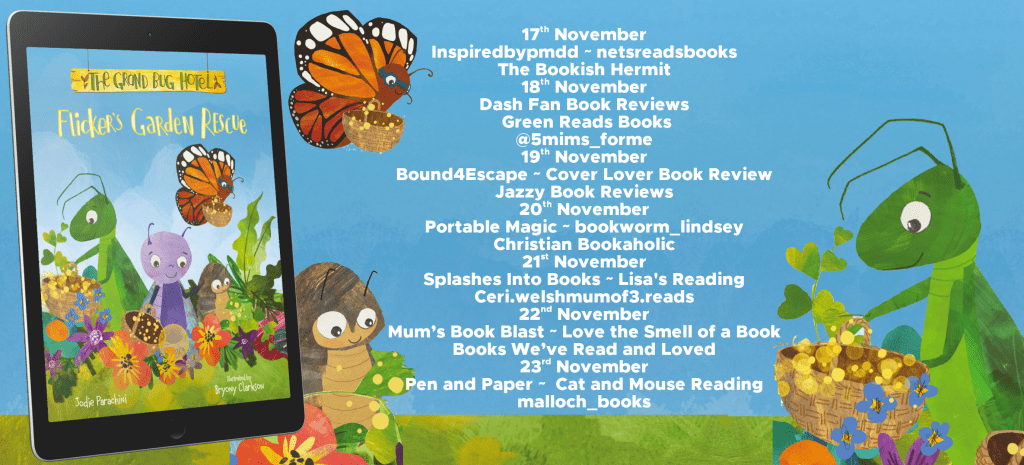
Anyway, put the above together, and I was thrilled to have the opportunity to be invited to take part in the book tour for Flicker’s Garden Rescue. Was I disappointed? Absolutely not! The illustrations are so gorgeous, the message is spot on, the story is sweet, and, although I doubt it was written as a tribute to our beloved late Queen, it seems fittingly poignant.

Here’s a screen grab of one of the stunning illustrations by Bryony Clarkson, who I’m pleased to say is fully credited on the cover. I could look at this all day.

Blurb

Flicker's garden Rescue book cover

Aitchoo! Queen Bee has the sneezies and is having trouble organizing this year’s pollination. Without pollen, the plants won’t be able to make the seeds and fruits for the annual Garden Party. Luckily, Flicker and her friends are on hand to save the day.

About the author

Jodie Parachini is a children’s author and editor. She lives in a village in Hertfordshire, England, where she loves swimming, gardening, and taking long, rambling hikes with a smelly dog. She can be found at www.JodieParachini.com

Bath time book fun

I remember the days when my son spent hours playing in the bath. That was before the teenager years where personal hygiene slipped down the priorities …

Anyway, the lovely Sue Wickstead sent me a proof copy of her forthcoming book, David’s Bathtime Adventure. Like all of her books, it’s a cosy read and beautifully illustrated by Jo Anne Davies. I do wish the illustrator was credited on the cover, particularly since the same illustrator has done all of Sue’s books so it’s a true partnership.

David's Bathtime Adventure book cover

Sue’s books tend to have a far higher word-count than the publishers typically favour – picture books are “supposed” to have 400 to 600 words and 24 pages (according to the ‘rules’). I haven’t counted but I’d guess this is around 1,000 words which makes it ideal to read aloud, obviously either before, during, or after bath time. It would be great if there was a waterproof version of this book!

Whilst on the face of it, this is a simple story of a familiar activity, Sue Wickstead is a teacher, and there is a subtle educational aspect woven in which ties to the ‘learning through play’ activity at the back of the book – finding out about what sinks and floats.

Blurb

Learning through Play (Water) Children love splashing and pouring, spraying and making waves. It enhances their creativity and imagination and provides opportunities for some wonderful investigation and scientific learning. Finding out what sinks, what floats, testing and ideas. Developing awareness of the physical world.

About the author

Sue Wickstead author picture

Sue Wickstead is a teacher and an author and writes children’s picture books.

Sue once worked with a playbus charity based in Crawley. This led her to write the photographic history book about the project. The ‘Bewbush Playbus’ book was published in 2012. Sue then began to write a fictional tale about the bus. ‘Jay-Jay the Supersonic Bus’, his number plate JJK261 gave him his name and has now been followed by more picture books (ten to date) which all indeed have a bus connection as well as links to her teaching journey. Her latest books are less bus focused, although they do sneak in, and cover familiar daily activities.

Sue is a regular visitor to this blog and you can see some of her other books featured here

https://lexirees.co.uk/2021/06/09/not-a-bus-book/

https://lexirees.co.uk/2020/07/20/hop-on-board-another-bus-journey-and-a-giveaway/

https://lexirees.co.uk/2020/02/10/why-sparky-made-me-cry/

https://lexirees.co.uk/2019/04/20/do-you-remember-play-buses-as-a-kid/

Some of Sue’s books have been entered and shortlisted in ‘The Wishing Shelf Book Awards’, her book ‘A Spooky Tale’ was a silver medal winner in 2019. It is a story written with her class in school and is aimed at the younger reader.

Bodies, brains, and bogies

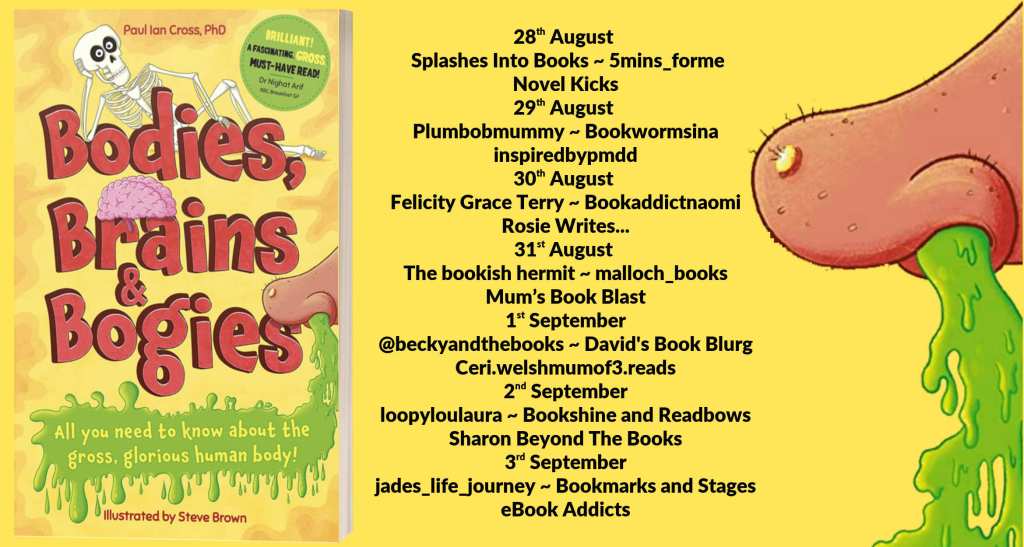
With a title like Bodies, Brains and Bogies, this could be a new horror movie, but it’s the latest addition to my non-fiction collection. And I’m very excited about it. If your kids like Horrible Histories, they’ll love this. Of course there are other similar books, but given kids devour these books faster than I get through novels on holiday, I reckon you can’t have too many.

There is of course lots of gross stuff in it, perfect for kids to absorb and then spew up at inappropriate times, but there is also a lot of information, presented in a really accessible way. For example, you’ve got to love a BPM chart that starts at zombie level. And I didn’t know that the shape of your nose affects the sound of your voice! But the best bit of all is the section on Body Positivity – what an important topic, and it’s handled so very well – which is then reinforced in the final pages with ‘Six steps to succeed in your skin’.

It wasn’t a surprise to me that the author has outstanding science credentials which, combined with an obvious passion for STEM, and I suspect a sense of humour like a 10 year old, make this book fun, accessible, and informative.

You’ve probably gathered I love this book, but just incase I haven’t shouted out enough, this is an absolute must for every home bookshelf and every school library.

Blurb

This fantastic title from Paul Ian Cross, the writer of How to Vanquish a Virus, takes the reader on a whirlwind tour of everything that’s disgusting, unusual and amazing about the human body. Find out everything about poo, pus and bogies, while learning a whole lot about how our bodies work hard in hundreds of fascinating ways to keep us alive.

With tons of hilarious and informative illustrations, it includes lashings of Paul Ian Cross’s trademark laugh-out-loud humour, in-depth knowledge and infectious optimism. It’s the perfect funny, accessible way to discover everything you’ve ever wanted to know about the human body, but were too grossed-out to ask!

About the author

Author Paul Ian Cross

Paul works in clinical research (developing new medicines) and he’s also a science communicator (presenting science to non-scientists). Paul specialises in vaccine development and has an interest in pharmacovigilance (the safety of medicinal products). His PhD research investigated the benefit-risk assessment of medicines, and how patients and the public can be more involved in their treatment decisions. 

Paul’s popular social media accounts (@DrPaulScience) are full of STEM-themed content for all ages, but particularly for parents and adults to share with the children in their lives. Paul is a member of #TeamHalo, a UN backed initiative where doctors, healthcare workers, and scientists share accurate information about healthcare, science, and the COVID-19 vaccines. In 2021, Paul was named as a ‘Luminary’ at the G7’s Vaccine Confidence Summit, in recognition for his science communication work on social media.

In addition to his research career, Paul has a passion for introducing children to STEM subjects, particularly reluctant readers. By introducing science creatively, he aims to spark their interest, allowing them to gain confidence with their reading. As a previous reluctant reader himself, he understands how hard it can be. But it’s all about making reading fun and interesting!