Bodies, brains, and bogies

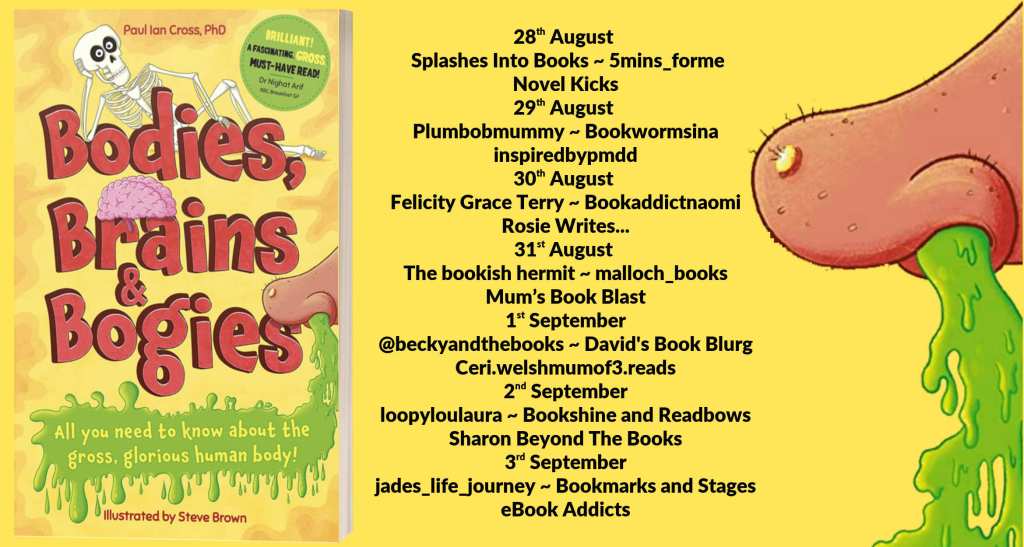
With a title like Bodies, Brains and Bogies, this could be a new horror movie, but it’s the latest addition to my non-fiction collection. And I’m very excited about it. If your kids like Horrible Histories, they’ll love this. Of course there are other similar books, but given kids devour these books faster than I get through novels on holiday, I reckon you can’t have too many.

There is of course lots of gross stuff in it, perfect for kids to absorb and then spew up at inappropriate times, but there is also a lot of information, presented in a really accessible way. For example, you’ve got to love a BPM chart that starts at zombie level. And I didn’t know that the shape of your nose affects the sound of your voice! But the best bit of all is the section on Body Positivity – what an important topic, and it’s handled so very well – which is then reinforced in the final pages with ‘Six steps to succeed in your skin’.

It wasn’t a surprise to me that the author has outstanding science credentials which, combined with an obvious passion for STEM, and I suspect a sense of humour like a 10 year old, make this book fun, accessible, and informative.

You’ve probably gathered I love this book, but just incase I haven’t shouted out enough, this is an absolute must for every home bookshelf and every school library.

Blurb

This fantastic title from Paul Ian Cross, the writer of How to Vanquish a Virus, takes the reader on a whirlwind tour of everything that’s disgusting, unusual and amazing about the human body. Find out everything about poo, pus and bogies, while learning a whole lot about how our bodies work hard in hundreds of fascinating ways to keep us alive.

With tons of hilarious and informative illustrations, it includes lashings of Paul Ian Cross’s trademark laugh-out-loud humour, in-depth knowledge and infectious optimism. It’s the perfect funny, accessible way to discover everything you’ve ever wanted to know about the human body, but were too grossed-out to ask!

About the author

Author Paul Ian Cross

Paul works in clinical research (developing new medicines) and he’s also a science communicator (presenting science to non-scientists). Paul specialises in vaccine development and has an interest in pharmacovigilance (the safety of medicinal products). His PhD research investigated the benefit-risk assessment of medicines, and how patients and the public can be more involved in their treatment decisions. 

Paul’s popular social media accounts (@DrPaulScience) are full of STEM-themed content for all ages, but particularly for parents and adults to share with the children in their lives. Paul is a member of #TeamHalo, a UN backed initiative where doctors, healthcare workers, and scientists share accurate information about healthcare, science, and the COVID-19 vaccines. In 2021, Paul was named as a ‘Luminary’ at the G7’s Vaccine Confidence Summit, in recognition for his science communication work on social media.

In addition to his research career, Paul has a passion for introducing children to STEM subjects, particularly reluctant readers. By introducing science creatively, he aims to spark their interest, allowing them to gain confidence with their reading. As a previous reluctant reader himself, he understands how hard it can be. But it’s all about making reading fun and interesting! 

Maths for babies – a book I wish I’d written

A little known fact is I’m actually an accountant – I’m a Fellow of the Institute of Chartered Accountants of England & Wales. So it’s not surprising that I thought Numberjacks was a great idea for a kids TV show, and I’m always curious about new maths focused books. What is surprising, is that I didn’t write 100 ways, 100 days to teach your baby maths myself! What a superb resource.

Blurb

Let your baby lead the way as you explore the wonderful world of maths together through 100 daily activities, stories, and songs. No flashcards, no worksheets, no right or wrong, and no maths anxiety Within this 100-day maths journey, you will discover:

  • Maths ability on entry to school is a strong predictor of later achievement, double that of literacy skills.
  • Babies seem to be born with an amazing number sense.
  • Parents have the power to show their babies that maths is enjoyable and not something to be anxious about.
  • Babies can enjoy maths activities while boosting other areas of development.
  • The best time to start enjoying maths is in infancy.

What about the effect of gender, culture, sleep, diet—even the type of pushchair you buy? 100 Ways in 100 Days to Teach Your Baby Maths holds the answers.

“…use this book. It really will be worth it.”- Tony Attwood, founder, The Dyscalculia Centre“I loved reading this book. The approach is imaginative but also tied to everyday life, making the holistic integration of a maths-friendly parenting style something natural rather than forced.”- http://www.thebookbag.co.uk“The simple and well-researched activities and advice ensure that everyone can give their children the best start in life.”- National Numeracy

About the Author

Emma Smith is a Fellow of The Institute of Actuaries and a Chartered Accountant. She is a double academic prize winner with a First Class Maths degree and a lifelong lover of maths. She has worked freelance as an actuarial exam counsellor, an assistant examiner, and a writer. Her front-cover articles include “Your Baby is a Genius!” in Baby London Magazine. While writing, Emma is ably assisted by her dog, Button, her daughter’s cat, Princess Marshmallow, and her son’s cat, Squeezy Paws.

Hopping corn science experiment

I just had to share this cool science experiment from the fabulous Suzie at StemSpark. Is it just me, or is this like making your own lava lamp? Love, love, love it!

Anyway, here are Suzie’s easy peasy instructions …

You’ll Need a clear glass container popping corn water baking soda white vinegar food coloring (optional)

Instructions 1) Fill your glass container with water and add a couple drops of food coloring.

2) Add your baking soda and stir well until it is all dissolved.

3) Add a small handful of popping corn kernels.

4) Add the vinegar and watch the corn start to hop up and down!

Hopping Candy science experiment

The corn will hop up and down repeatedly in your container for over an hour.  It’s so much fun to watch (mesmerizing would be the best word to describe it). The experiment creates a great opportunity to talk about gases, liquids, and solids with your child.

Basically, the science behind the activity is that when the baking soda and vinegar combine, they react to form carbon dioxide (CO2) gas.  The gas forms bubbles in the water, which enclose the corn kernels.  The bubbles lift the kernels up to the surface, and when the kernels get to the surface, the bubbles pop, and the kernels sink again.

Calling all budding entrepreneurs

You’re never too young to set up your first business, whether it’s the lemonade stand on the street or some fancy gaming app. My son has several business ventures up and running including break-time haircutting services for his friends at a bargain £3 (compared to £10 at the local barber shop). Sadly, the business plan collapsed as school were rather less than impressed by the resultant mullets and mohicans, but I was secretly quite chuffed with the initiative.

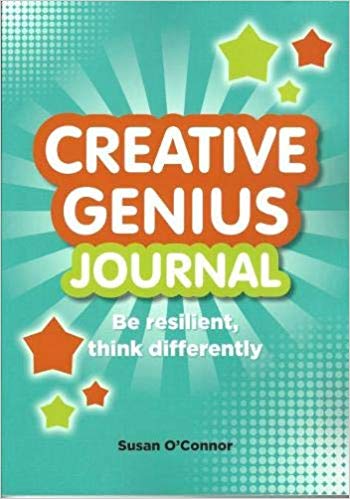
I’ve got a Creative Writing Workbook coming out in October, so I’ve been spending a lot of time in the non-fiction world recently and was excited to be offered a chance to review the Creative Genius Journal.

Creative Genius Journal cover


The blurb says

With 9 challenges that build the skills to help inform and develop a child’s resilience, imagination, improve their creativity, encourage drafting, sketching, reviewing and self-correcting of information and ideas. These are important, as alongside problem solving and working with others, they are the skills they will need for their futures.

But to my mind, it offers even more; it encourages those first steps towards launching a business. The activities include things like design a piece of apparatus for an adventure playground (the next Dyson?), or create a character to advertise a new drink (very Sir Alan Sugar/ The Apprentice). Each challenge draws in lots of aspects but they’re broken down into fun, manageable chunks.

GIVEAWAY TIME!

I want to have a go myself, but I’ve resisted and have a pristine copy to give away to one lucky reader (UK only, sorry).

You can enter here …

https://kingsumo.com/g/kd8d0c/creative-genius-journal

About the author

Susan O'Coonnor

Susan has taught for over thirty years in schools and colleges and has produced maths games and written several books for children and teenagers – ‘Mighty Memory Tricks’, ‘High Five Jive’, ‘Be Positive’ and ‘Creative Genius Journal’. These practical books are fun but have genuine educational benefit. Currently, she is writing for Bloomsbury Publishing.


Lessons from a 9 year old coder

I’m literally bursting with excitement at introducing my guest today. Yeva Patterson is an ultra cool 9 year old coder. She’s a big supporter of girls in tech and STEM, and I reckon she’s probably the youngest VR developer in the world! Today she’s sharing her tips to help get other kids into coding, and a special selection of book recommendations on coding for kids.


So over to Yeva …


How I Got Into Coding

My parents are developers and they started teaching me how to code when I was 5 years old.

They were developing a mobile educational math app and they let me help. I would build levels for it and they actually put them into the app! I was so excited that people would play what I built so I kept going, learning more about coding and finding out what else I could create.

I realized that learning to code allowed me to be creative in a whole new way. I learned that you can code computers to do just about anything.

I found code.org tutorials particularly fun and helpful and progressed through their curriculum. I enjoyed getting their certification achievements. After I learned some coding basics I got to start using Unity3D game engine and worked on creating some fun apps. Unity now has a free asset called Unity Playground that is a simplified version of the more complex game engine. I’ve been playing with it recently and it’s really good for early programmers to first learn on Unity.

Late in 2017 I got to try virtual reality for the first time. Once I put the headset on, I fell in love! It was so much fun! I could fly! I could ride in Santa’s Sleigh and deliver presents and I could float above earth at the space station. Around the same time I was asking my parents for a rock wall but we didn’t have any space for a real one. So I decided the next best thing would be to climb in virtual reality so I built a climbing experience in VR. I made it into the shape of Google’s logo for their Doodle for Google contest because the theme that year was to doodle what inspires you. I am inspired by VR and the limitless possibilities of what you can do with VR.

What I love about VR is that it is not only really fun, it is also really useful. You can learn things in VR in such a different way. You get to be inside an environment and experience it and interact with it in a whole new way. My parents said that they could see how enriching learning in VR was for us. That’s when they decided to make a VR app to teach computer programming in VR. It’s called vCoder and it is the first virtual reality app that teaches coding in VR. I am helping them build vCoder because it is really entertaining to code in VR and I want other kids to learn how fun programming can be. This is really exciting because kids can enjoy and immerse themselves in an engaging VR world. Along the way they learn a valuable skill and see that they can learn to code too.

There are some great resources for kids to start learning how to code. I recently had a great time presenting to a class of Kindergarteners and First graders and I recommended they can easily get started at Code.org. They have tutorials even for kids that don’t read yet. I also recommend Girls Who Code.


I really enjoy teaching other kids about coding and have a passion for supporting and encouraging more kids to learn how to code. So I made some video tutorials on my YouTube channel, Yeva Codes, that helps young kids get started with code.org. I love doing it! I’m making more coding tutorials and will be adding them to my channel.

I hope to inspire other kids, and especially young girls, ​to learn how to code so they can create their dreams too!


These are my top books for getting kids into coding:


Hello Ruby Adventures in Coding (Journey Inside the Computer and Expedition to the Internet) by Linda Liukas

Girls Who Code: Learn to Code and Change the World – by ​Reshma Saujani

Girls Who Code: The Friendship Code – by Stacia Deutsch How to Code a Sandcastle – by Joshua Funk

Secret Coders – by Gene Luen Yang and Mike Holmes Dot – by Randi Zuckerberg


Wow! Thanks very much Yeva.

Readers, you can see why I was so excited! I can’t wait to show my family these books, plus the websites and apps, and see where this journey takes them. I hope this inspires them, and many other kids, to give coding a go.

If you’ve got any questions, I’m sure Yeva would be delighted to answer them! You can even follow her on Twitter on @yevacodes