Screen Shot 2018-08-10 at 13.09.51


I’m sharing this great blog from Fraser’s Fun House. My kids are too old for this now, but it looks like a fabulous resource. There is masses of free stuff on the site, but the premium option that Fraser’s Fun House reviewed is only £9.97 a year and promises lots of extras.

Like most kids Leo loves colouring and writing and over the years we have purchased what feels like hundreds of books and pads to quench his thirst for creativity. Realising that we were spending a small fortune to keep him supplied we ventured online to find colouring sheets and learning resources to print off, figuring […]

via Review: Banish Boredom with Mrs Mactivity’s Learning Resources — Fraser’s Fun House

Why the kids packing has hilarious results

“What? You’re packing for him?” My mother is outraged. “You packed all your own stuff for a holiday from when you were nine and it was perfect.”

Perfect? Really? I have no recollection of ever packing myself, or being praised for it.

I’m always puzzled when I see people dragging vast suitcases at the airport. What have they got in there? I can’t imagine taking so much stuff for a week on a beach? Skiing, yes. Camping, yes. But a week in Spain? I’m not actually sure I own that much summer clothing. I’ve even packed my espresso machine and my bag is still smaller. Actually I would trade a pile of dresses just to make space for the espresso machine if it came down to it.

I’m a member of a great decluttering group on Facebook who were lamenting the challenges of packing. They were shocked when I said my last trip was ten days and I travelled hand baggage only and that included my horse riding helmet. And a pair of boots. And my espresso machine. So I guess I pack light.

Anyway, it’s all granny’s fault that the kids are packing for themselves this year. I’m off duty.

“Everything’s packed mum.”

DS Trip 1

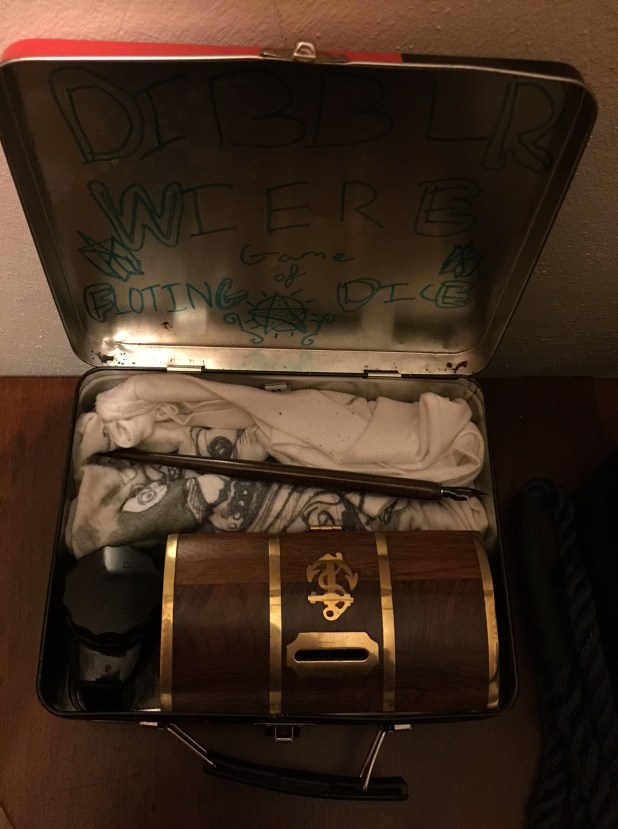
  1. One t-shirt
  2. A quill pen and bottle of ink
  3. A wooden treasure chest

It’s all very neatly packed in a 5 inch metal dinosaur tin. Even by my standards, that is extremely light packing.

IMG_8423

Apparently this is enough for a week.

DS Trip 2

  1. Chopsticks
  2. Mouse for the home computer
  3. Pillow. Apparently this is not negotiable, it is coming with us. Does it count as an item of hand baggage itself? Otherwise I’m going to be impersonating a pregnant lady through check-in.
  4. Flip flops. We’re off on a family trip to the north of Scotland. I add a raincoat.

Niece 1

  1. Cropped vest top – striped
  2. Cropped vest top – ribbed
  3. Cropped vest top – sparkly
  4. Denim mini skirt

Yup this is for the Scotland trip too. The midges are going to have a field day. I almost comment on the scant size of the clothing but then realise I am turning into my mother, so bite my tongue.

Top tips for light packing

My three top light packing tips would be

  • Pick a colour scheme so you can mix and match.
  • Throw things out/ give to charity when you finish. I don’t bring flip flops home at the end of summer as they are inevitably on their last legs by then. Ditto t-shirts and sun dresses that I know I will replace next year.
  • Accessories allow you to change the look. I love my jewellery pouches. I actually have two – a larger one for city breaks and a smaller one for outdoorsy trips.


IMG_1759

Large jewellery pouch from Stella & Dot. I love the separate compartments.


Would you trust the kids to pack for themselves?

What’s the strangest thing you (or they) have packed? I once took an anchor instead of a suitcase on a flight. That got strange looks when it arrived on the luggage belt in Turkey.

Sure fire solution to happy hiking with teenagers

It’s only the first week of the school holidays and DS has a full schedule of gaming planned. Tactics for detaching teenage DS from his gadget need to be more cunning. A spot of googling later, and I have an idea.

Me: “Shall we go for a walk?”

DS: “Nah.”

Later.

Me: “Do you fancy trying orienteering?”

DS: “Meh.”

Later.

Me: “Have you seen the App called Geocache?”

Quick text to the grandparents to announce my success. Turns out they know all about geocaching. I’m going to assume I’ve had my head under a rock for the last decade but, just in case anyone else managed to miss it, Geocaching is a global online treasure hunt. No gadget detachment required. And it’s free to join in.

All you need to do is download the App onto your phone and off you go. Perfect.

So off we went.

Then back home we went.

You also need a pen and a stash of small toys/ trinkets.

Second attempt.

DS is thoroughly enjoying himself. His nose is two inches from the screen so he may be missing the scenery, but he has map read, used a compass (albeit a virtual one), and hiked for four hours without even realising it. Virtual trophies mean the gaming addiction of always needing to reach the next “level” has kicked in. Currently Geocache are running a “Hidden Creatures” event where you get a Bigfoot for finding one cache, Unicorn for five caches, a Kraken for seven caches etc. So instead of just doing two or three caches, we’ve done seven, including retracing our steps a few times when we (he) lost the path.

This little chap from a great cache is about to travel 600 miles to be re-hidden in Scotland.

Geocache treasure

Grubby hands, great cache

Some of the caches are literally the size of a fingernail. Needle in a haystack anyone?

Nano geocache

No, the cache isn’t the large orange crystal thingy. It’s the tiny black metal capsule.

By mid afternoon, I’m carrying the dog (he clearly needs to up his fitness) and have realised flip-flops were not the best choice of footwear.

DS wants to go on. Iced coffee wins. Plus the dog is actually quite heavy.

Day Two.

I’m feeling quite experienced here and ready for the hike: I’ve got my pen, sensible shoes, and the dog is staying at home. Then DS raises the bar. Premium membership unlocks more challenges. He starts babbling about multi-caches and earth-caches for only £4.99 a month, or 12 months for £24.99. At just over £2 a month, I’m happy to take out a year’s membership based on the enthusiasm yesterday and the fact we can use it next week when we visit family in Scotland. Now he’s armed with the Premium membership whilst I have the Basic (free) one.

So today he logged eight caches, whilst I’m only able to log four. Cue much gloating that he reached the Sphinx souvenir level and I only got to Mermaid.
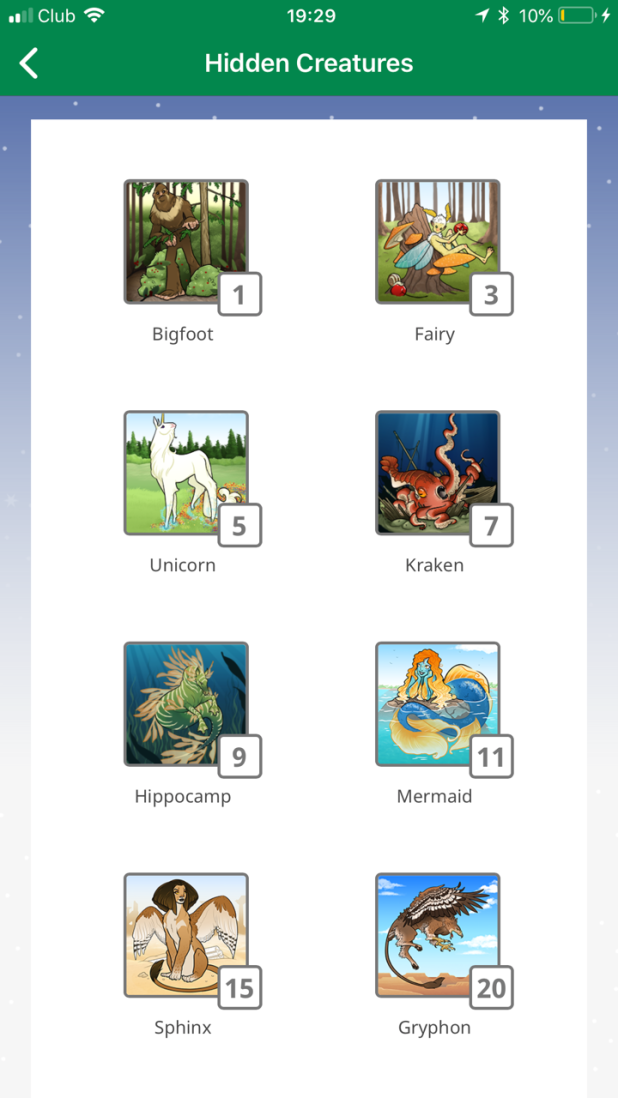
Geocache souvenirs

Geocache levels – just like any other online game.

Day Three.

I know we’ve only just broken up, but I want to buy new school shoes before they sell out of every sensible/ acceptable (depending on your perspective) style. So we’re doing an urban trail at the same time. This means we need to not look suspicious to “Muggles”. I now understand why people always seemed to be lurking around particular lamp posts in the town centre.

DS misreads a set of instructions as “Need to rummage in bins” causing me to grab his phone. Luckily, I confirm it actually says “No need to rummage in bins.” The bin men, taking a tea break on a bench, very kindly ask DS if he’s lost something as he crawls beneath the bench. Turns out they like Geocaching too.

By the time I’ve lugged the school shoes half way round town, I need coffee. DS discusses Geocaching with the waitress. Seriously, am I the only person in the country who didn’t know about this? And I’m not sure the shoes fit. I think DS was in a rush to find the next cache.

The good things

  • Outside
  • Suitable for all ages
  • Basic membership is free. My recommendation would be this is more than enough if you have younger children. The Premium challenges can take ages – the one in Chichester Cathedral took us about an hour – but for teenagers, I reckon the more complex puzzles are well worth the investment.
  • Stealthily educational, particularly at the Premium level. We did an earth cache which required the identification of various types of rocks in a church wall – is limestone sedimentary (which I misread as “sedentary” but I think I got away with it) or igneous? Whoever created the cache had provided loads of information and pictures.

The downsides

  • Drains phone batteries faster than I drink espresso. We took a phone on full charge plus a spare battery charger pack and totally drained it too. I was worried that it would be heavy on our data allowance (recalling a scary phone bill after an afternoon Pokemon hunting in the park a while ago), but actually it hardly used any. DH says that’s because it’s using the GPS system or something like that. No idea why that would make a difference but I’m happy enough to just nod.
  • Empty caches. This seems to be more of an issue at the Basic level. Sadly, some people haven’t understood the concept of replacing whatever you take out with something of equal, or higher, value. When we found these, DS decided to put a small toy in the cache so any younger child who comes along after us isn’t disappointed.
  • Rubbish hints. Some of the hints are great, often cryptic (“I’m always looking at you, but you can call me rocky”) or sneaking in more stealth education (“find the sycamore tree”). Others just say “It’s on the signpost, LHS” which isn’t exactly a hint, is it?
  • A simple shopping trip will take five hours.

Overall, a massive hit for all of us, except the dog. You’ve probably been geocaching for years but if, like me, you somehow missed it, this is a superb kids activity. And I really need to say a huge thanks to everyone who takes to time to create and maintain their routes.

Do let me know if you’ve had a go. Do you agree with the Premium version really being for older kids/ grown ups?

Judging a book by its cover? 10 tips

A good book cover boosts sales, both of eBooks and paperbacks. We really do judge a book by its cover. Getting the right cover takes a huge amount of time and effort, but here are 10 tips to help you get started.

  1. Establish your style. I include colours, fonts and images that might inspire my cover – of course it’s going to be distinctive too, right! Clarity here will save you time when you start browsing designer portfolios for your shortlist, and help you avoid expensive mistakes when you brief later your designer.
  2. Look at different genres. There are definite “themes” i.e. dragons = fantasy, ladies in long dresses = historical fiction, ragged fonts = crime. Readers will make a snap judgment on the type of book based on this broad first impression, so don’t confuse them by using dragons for a romance. It is highly recommended to stay in the genre and not try anything too different to avoid accidentally losing readers.
  3. Check out any recent trends. This article looks at some key trends for 2018, although I think they should rename the page link from “trashed-7”! https://the-digital-reader.com/2017/12/06/__trashed-7/
  4. Analyse other covers to try to understand what does or doesn’t work, and why. The website https://www.thebookdesigner.com/2011/08/monthly-e-book-cover-design-awards/ has a monthly competition with brief comments on good and bad covers. It is well worth spending some time on, but it would be great if you could sort the designs by genre. For more detailed analysis of a few covers, I recommend this webcast https://selfpublishingadvice.org/designing-book-covers-that-sell-the-7-must-haves-derek-murphy/?utm_campaign=shareaholic&utm_medium=email_this&utm_source=email
  5. Research designers of covers that you like. There is no doubt this is time consuming, but at least you know what their style is and if it is in line with what you want. IMG_9250
  6. Alternatively, you can use an agency. Services like https://99designs.co.uk/book-cover-design will provide lots of options and ideas through a competition. With 99designs you set some parameters around the type of cover you want (this is where having gone through the above steps will really help you) and designers from around the world can pitch for your project. There are a range of pricing packages.
  7. DIY it. Not sure I am brave enough, but if you are more artistic than me or on a strict budget, you can design your own cover. There are lots of templates you can use. I like the simplicity of Canva https://www.canva.com, or you could look at Adobe Spark https://spark.adobe.com/make/book-cover-make. I recommend this podcast to get you started https://selfpublishingadvice.org/beginners-self-publishing-salon-podcast-designing-your-own-cover/
  8. Is it part of a series? If so, before committing to a design, it’s worth considering how you could link the covers by changing elements but keeping a recognisable link. I love these covers by Kristina Beck for the Collide series – they are clearly linked, but still different.
  9. Computer vs. physical design? It’s likely you are designing on a computer, but if you do want to go one step further, this article by Ben Denzer shows the impact incorporating physical layering can make to the final visual. http://lithub.com/secrets-of-the-book-designer-creating-something-from-nothing/
  10. Don’t panic! If you change your mind you can always relaunch with a new cover – lots of authors do. It’s particularly easy if you are indie published. With print-on-demand and eBooks you won’t even have a big pile of books in the old cover to dispose of either. Take a look at these before and after shots from the hugely successful Wool series by Hugh Howey for example!

Whatever you decide, have fun and good luck!

Featured image by Karim Ghantous on Unsplash.com – thanks!


The Alcina Is A Stunning Boat In Real Life

Top advice for authors usually includes “Write about what you know” – well I know nothing about smuggling, but I do know a lot about sailing so that’s where the whole idea for The Relic Hunters started.

Finn and Aria’s boat is based on a real boat, Indianna. We anchored next to Indianna in a small bay in a Greek island and started chatting to the owners, Roger and Anne. They lived aboard Indianna with their two dogs, Indi and Sollie. The story is that one day, after (quite) a few lunch time drinks, they decided to quit their jobs and buy a boat. Sailing round the UK while they were learning the ropes seemed a sensible idea given they were both novices, but this was in January. Unsurprisingly, a couple of hundred miles north, Anne announced “if you don’t turn this boat and head somewhere warmer, I’m getting off.” And that started a nine year trip through the Mediterranean.

Indianna is a lovely ketch – solidly built, with beautifully varnished woodwork down below and a deep cockpit.

P1000274