Do you remember play buses as a kid?

I’m thrilled to introduce todays guest, Sue Wickstead, as we recently did a joint creative writing workshop for kids at Crawley WordFest. Sue writes picture books based on the real play buses inspired by her work with the children’s charity, The Bewbush Playbus Association (is it only me that finds that a terrible tongue twister?!?). She’s also written a non-fiction photographic history book about the original bus which is worth a look too.

C22FFA56-CF81-42DF-BB8D-8205219F21ED

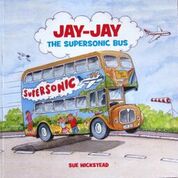
If you scroll down, there’s a giveaway competition for one of the books in the series and a free build-your-own-bus toy. Before we get there though, let’s take a look at the first book in the series, Jay-Jay The Supersonic Bus.

I have to say this is quite text heavy for a picture book: it’s really closer to a chapter book. Personally, I’d be tempted to reprint in a chapter book size format rather than laid out as it is in gate big square picture book style, but the illustrations are really lovely, so I would still want them. Ah it’s tricky! I wonder what the pictures would look like converted into black & white? Actually that could give quite a nice image.

Anyway, I reckon this is perfect for that tricky age where the kids are starting to read independently but absolutely insist on lots of pictures. The language itself is simple and straightforward. If you’re bored to tears with Biff and Chip, and who isn’t – can anyone tell me why schools still insist on using this dull and dated series? – then this is well worth a look. Overall, I can see this working really well for KS1 (UK school system – ages 4-7).

Blurb

Jay-Jay the bus is rescued from the dirty scrap yard, where he was sadly gathering dust and cobwebs. Feeling nervous yet excited, he’s taken to an airport where he is magically transformed into a ‘Playbus’ full of toys, games and adventure.

A fictional tale based on a real-life bus ‘Supersonic’, which flew in the imaginations of the many young children who visited it.
SU8ZW_0I

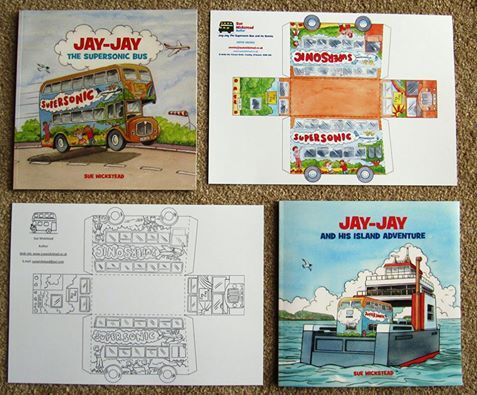
Giveaway to Win a copy of Jay-Jay and the Island Adventure (UK Only)

http://www.rafflecopter.com/rafl/display/33c69494213/?

*Terms and Conditions –UK entries welcome.  Please enter using Rafflecopter.  The winner will be selected at random via Rafflecopter from all valid entries and will be notified by Twitter and/or email. If no response is received within 7 days then Rachel’s Random Resources reserves the right to select an alternative winner. Open to all entrants aged 18 or over.  Any personal data given as part of the competition entry is used for this purpose only and will not be shared with third parties, with the exception of the winners’ information. This will passed to the giveaway organiser and used only for fulfilment of the prize, after which time Rachel’s Random Resources will delete the data.  I am not responsible for despatch or delivery of the prize.

And another special offer:A free 3D card bus can be claimed via the website site ‘Enquiry button using ref code JJay

Additional bus models and books also offered as a promotion on request.
FRU-fdzk

And if you miss out on the giveaway, Jay-Jay the Supersonic Bus will be 99p until 22ndApril. Purchase Links –

http://bit.ly/JJKSupersonic– Amazon .co.uk

http://amzn.to/2BxvU2l– Amazon .com

Author Bio

a1zfU718

I’m a teacher and an author and have currently written six children’s picture books with a bus theme.

For over 20 years, alongside my teaching career, I worked with a Children’s Charity, The Bewbush Playbus Association, which led me to write a photographic history book about it.

I soon found that many children had never been on a bus before, let alone a ‘Playbus’ and they wanted to know more. I decided to write a fictional tale about the bus, his number plate JJK261 gave him his name.

I also undertake events and author bookings and love to share the story. There are also a few more stories in the writing process, with links to real events and buses.

The story has been read in many schools in the south-East of England, where I teach as a cover teacher, it is always well received and certainly different.

Social Media Links –

https://www.suewickstead.co.uk/

Facebook: – Author Page http://bit.ly/2kEEhPq

http://bit.ly/2kXfjdj– Bewbush Playbus

http://bit.ly/2BZiews– Teacher in the cupboard

Twitter https://twitter.com/JayJayBus


Exclusive interview with author Claire Fayers

When I’m in schools, I’m often asked for book recommendations, and Claire Fayers’ new novel, Storm Hound, has been top of my list ever since I read it. It has the best opening paragraph EVER!
51-Mh5wo6QL._SX328_BO1,204,203,200_
So I’m super excited that she agreed to an interview …
What are you working on now? Is there a potential sequel to Storm Hound?
I’m currently working on a couple of new proposals to send in to my publisher. It’s too soon to say which one will be my next book but I’m having great fun playing with ideas. I would love to write a Storm Hound sequel. It’ll be up to my publisher but if Storm Hound does well you never know. I’m keeping my fingers crossed.
Could you share any childhood pics either of you in the Welsh hills or of you writing?
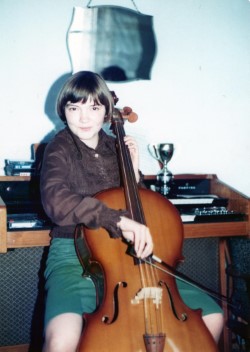
I wish I could, but my parents didn’t take any pictures of me when I was growing up. All I have is one photograph of me holding my cello after I won the cup for music in primary school. Everyone assumed I’d grow up to be a music teacher. I didn’t know it was possible to be an author back then.
thumbnail_Claire as child
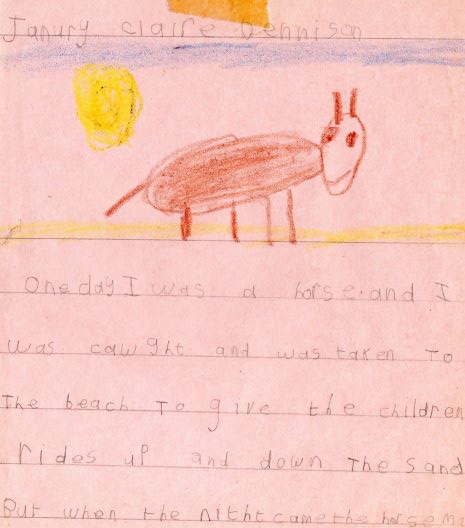
To make up for the lack of photos, here’s a pic of an early story I wrote in school. I liked writing about animals even then!
horse story 1
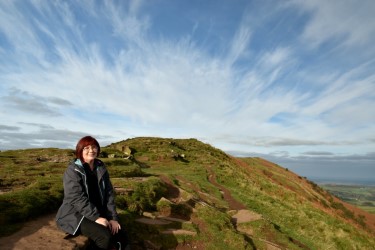
And here’s another of me taken last year, sitting on top of Mount Skirrid where Storm fell from the sky.
thumbnail_Claire on Skirrid
Did you have any pets as a child?
Yes, loads. We had guinea pigs, a rabbit, two dogs and a succession of hamsters (not all at the same time, I hasten to add!) But the pet that I truly loved above all others was my cat Mitzi. She was an ordinary black and white moggy. She died when I was about twelve and I didn’t get another cat until I owned my own home, much later. Obviously, I had to write a cat into Storm Hound – look out for Nutmeg.
What are your top tip for parents to encourage their youngsters to write?
Fill your house with books. Make regular trips to the library with your children as a love of writing usually starts with a love of reading. Make up stories with your children. Lead by example and set aside some time to write together. Keep a stash of fun pens and paper in different colours. Don’t correct or criticise your children’s efforts. Encourage them to write letters to relatives (and get the relatives to write back – nothing beats getting your very own letter through the post!)
And before you go, this is a tricky one: Michael Morpugo or Phillip Pullman?
Oh gosh. They are both masters, and their books are so different it’s hard to choose. But my reading (and writing) habits do tend to go towards fantasy so I’d have to say Pullman.
Thanks so much for a fun interview.
Thanks Claire! I didn’t know you played cello and wrote stories about horses as a kid – me too.
If you haven’t come across Claire before, here’s some more info.

Biography

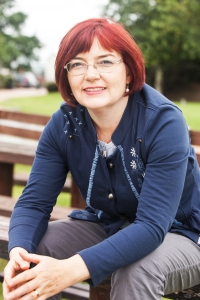
Claire Fayers-4573web

Claire Fayers grew up in South Wales, studied English at the University of Kent, and is now back in Wales where she spends a lot of her free time tramping around castles in the rain, looking for dragons.

She has worked as a church caretaker, a shoe shop assistant, in accountancy, in health and safety, in IT, and in a library. Only one of these prepared her in any way for life as a full-time author. She works from her home in Cardiff, sharing her workspace with a pair of demanding cats and an ever-expanding set of model dinosaurs. Storm Hound is her fourth book for Macmillan Children’s Books.

Website www.clairefayers.com

twitter @clairefayers

facebook www.facebook.com/clairefayersauthor


Blurb

Storm of Odin is the youngest stormhound of the Wild Hunt that haunts lightning-filled skies. He has longed for the time when he will be able to join his brothers and sisters but on his very first hunt he finds he can’t keep up and falls to earth, landing on the A40 just outside Abergavenny.

Enter twelve-year-old Jessica Price, who finds and adopts a cute puppy from an animal rescue centre. And suddenly, a number of strange people seem very interested in her and her new pet, Storm. People who seem to know a lot about magic . . .

In Claire Fayers’ electrifying adventure Storm Hound, Jessica starts to see that there’s something different about her beloved dog and will need to work out which of her new friends she can trust.

Beach hut escapades

Every time I walk my dog past the cute wooden huts on West Wittering beach, I dream of owning one. I’ve even got a shortlist of my favourites. I chat to the owners of several regularly and they tend to be passed down the generations, and every hut has a story to tell. So fellow Chindi author Angela Petch’s latest book, Mavis & Dot, totally appeals. For the avoidance of doubt – this is a grown up book not a kids book! It was written in memory of a friend who passed away from ovarian cancer, and the icing on the cake is that all profits from Mavis and Dot will go towards cancer research, so I’m adding this to my “to be read pile”. Now I just need the weather to warm up a bit – deck chair and thermos at the ready, since we’re going a bit retro.

Mavis and Dot Front Cover in RGB mode for screens jpg

Anyway, I’ve invited Angela onto my blog to chat about the themes and inspiration for her book, so over to her.

Loneliness and Kindness

Mavis and Dot are two very different ladies who retire to the Sussex seaside at about the same time. They forge an unlikely friendship and end up having a few adventures together. I don’t think for a moment that they set out to be kind for a reason, but they end up helping each other through their loneliness. True kindness lies within giving, without expecting a return.

When Mavis— always on a mission to lose the inches— is incapacitated after a strenuous session of an exercise class (Bums and Tums), Dot came over as soon as she could, producing from her shopping bag a huge slab of fruit and nut chocolate.

‘I remember you saying this was your favourite. It was reduced at the Co-op because one end was a little melted, but it should taste fine. And I bought three fruit cakes. Their sell-by-date was last week but that doesn’t matter. It will act like penicillin for you, what?’ she chortled, ‘a little bit of mould will save you from having to take antibiotics.’

Mavis knew that Dot was only being kind but how was she supposed to shed pounds for her ballroom dancing classes with all these goodies wafted under her nose?

Dot needs support from her new friend later, even though she doesn’t realise. She’s a complex, prickly character. Mavis is the first person to whom she pours out her heart, after more than fifty years of keeping a personal tragedy to herself. Afterwards, they put on the kettle (there is a lot of tea drinking in Mavis and Dot).

‘Tea again,’ laughed Dot, ‘we’ll start to look like teapots.’

I loved William books, written by Richmal Crompton and all of Enid Blyton’s Famous Five Adventures when I was little. So, I’ve given Mavis and Dot some grown-up adventures. Dot comes across a couple of illegal immigrants hiding in a beach hut and she decides to rescue them, not without complications. She is determined to help them in their quest for a better life and invites them back to her house.

This act of kindness gains her a family. At the end of the book, after sharing Christmas Day with most of the characters in the book, Dot sits quietly by the fire.

It had been one of the best days, something to bottle for gloomier times. She thought about the unpredictability of life; how bad could be softened by good; how old clichés like “never give up” were so true. Because if anybody had told her this time last year, she would be spending December 25th with strangers who were now like family, she would have laughed in their face.

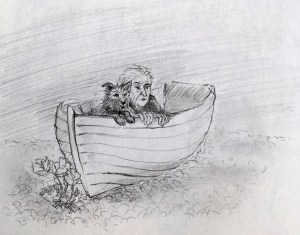
By the way, I love that her illustrations by Gill Kaye, editor of Sussex magazine, Ingenu/e are simple pencil sketches, like I used in Eternal Seas. Here’s one of Dot staking out the beach hut at night with her dog, because she’s convinced somebody is using it at night.

Stakeout

Blurb

Introducing two eccentric ladies who form an unlikely friendship.Meet Mavis and Dot – two colourful, retired ladies who live in Worthington-on-Sea, where there are charity shops galore. Apart from bargain hunting, they manage to tangle themselves in escapades involving illegal immigrants, night clubs, nude modelling, errant toupees and more. And then there’s Mal, the lovable dog who nobody else wants. A gently humorous, often side-splitting, heart-warming snapshot of two memorable characters with past secrets and passions. Escape for a couple of hours into this snapshot of a faded, British seaside town. You’ll laugh and cry but probably laugh more.

Biography

AP 20e

Angela Petch lives in the Tuscan Apennines in summer and Sussex in winter.

Her love affair with Italy was born at the age of seven when she moved with her family to Rome. Her father worked for the Commonwealth War Graves Commission and he made sure his children learned Italian and soaked up the culture. She studied Italian at the University of Kent at Canterbury and afterwards worked in Sicily where she met her husband. His Italian mother and British father met in Urbino in 1944 and married after a wartime romance.

Her first book, “Tuscan Roots” was written in 2012, for her Italian mother-in-law, Giuseppina, and also to make readers aware of the courage shown by families of her Italian neighbours during WW2. Signed by Bookouture in 2018, this book will be republished in June 2019. Another Tuscan novel has been commissioned for 2020.

“Now and Then in Tuscany”, a sequel, was published in April 2017 and features the same family. The background is the transhumance, a practice that started in Etruscan times and continued until the 1950s. Her research for her Tuscan novels is greatly helped by her knowledge of Italian and conversations with locals.

Although Italy is a passion, her stories are not always set in this country. “Mavis and Dot”, published at the end of 2018 and sold in aid of Cancer Research, tells the story of two fun-loving ladies who retire to the Sussex seaside. They forge an unlikely friendship and fall into a variety of adventures. Ingenu/e Magazine describes it as:“Absolutely Fabulous meets Last of the Summer Wine… a gently hilarious feel-good book that will enchant and delight…”.

A prize-winning author, member of CHINDI authors and the RNA, she also loves to travel and recently returned to Tanzania, where she lived at the start of her marriage. A keen tennis player and walker, she also enjoys spending time with her five grandchildren and inventing stories for their entertainment.

Her short stories are published by PRIMA and The People’s Friend.

Links

Angela’s Website and Blog

Facebook page

Twitter

Mavis & Dot book on Amazon


Where did the children go?

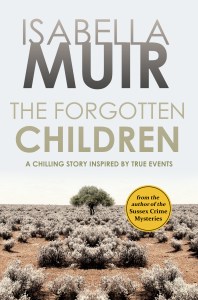
Continuing my series of mum-investigator mystery books, here is The Forgotten Children by Isabella Muir. I’ve read all her Janie Juke series and absolutely loved them, but this is different. It’s still got her trade-mark gentle tone and steady pace, but the topic is much more personal, and therefore raw.

I had expected more of the story to be based in Australia so was a bit surprised to find the first road trip was to Anglesey, and more time to be spent on the historical aspects, but this is focussed on Emily’s own search and her own feelings. On this level, it works very well, but if you’re expecting something more closely aligned to Empty Cradles by Margaret Humphreys, or the almost identically titled non-fiction The Forgotten Children: Fairbridge Farm School and its betrayal of Britains Child Migrants by David Hill, you might be disappointed. That is just the inspiration for the story, not the plot. To be clear, it’s totally my fault – I should have read the blurb more carefully – I think I was influenced by the outback cover photo.

Anyway, the big issues the story really tackles are the narrow-minded UK attitudes towards unmarried mothers and forced adoption. And the scary bit is, this is set not that long ago. The similarities between Emily and her own mother were a surprise (worded carefully to avoid spoilers). And as additional characters are introduced (particularly Walter and Patrick), the story picks up momentum, and I read it in just a few evenings.

The Forgotten Children isn’t part of a series, but I’m really hoping for a fourth Janie Juke book soon!

The blurb

the forgotten children paperback front

A woman’s search to find her son uncovers the shocking truth about one of Britain’s darkest periods

Struggling with the demons of her past, Emily is a children’s author with a dark secret, and a guilt that threatens to consume her.  For twenty years she has lived in Brighton, England, trying to forget the day they took her baby from her, just hours after he was born.  But now, in the summer of 1987, she decides to begin the search for her son.

Emily takes refuge in a small town on the Isle of Anglesey to plan the search, where she meets Walter, a gentle stranger, who helps her with his words of wisdom and kindness.  But it is when she decides to return home to Hastings, that she really has to face her demons.

Estranged from her parents when she was just sixteen, Emily is shocked by what her mother has to tell her about events that occurred before Emily was even born.

Beside her, throughout her search, is Emily’s beautiful Irish friend, Geraldine, recovering from her own sad experiences.  Together they uncover a truth that shocks them all.

 The Forgotten Children draws the reader into lives affected by narrow-minded beliefs and blinkered thinking at the highest level. Children who weren’t allowed to be born, children who were abandoned, and children who were taken, forced to lead a life thousands of miles away from everyone and everything they knew – leaving scars that may never heal.

At its heart, The Forgotten Childrenis a story of survival, but the journey that Emily has to take is painful.  Even more so because she knows it was allowed to happen by individuals, religions and governments, who should have known better.

Win a signed copy of The Forgotten Children (UK Only)

*Terms and Conditions –UK entries welcome.  Please enter using the Rafflecopter box below.  The winner will be selected at random via Rafflecopter from all valid entries and will be notified by Twitter and/or email. If no response is received within 7 days then Rachel’s Random Resources reserves the right to select an alternative winner. Open to all entrants aged 18 or over.  Any personal data given as part of the competition entry is used for this purpose only and will not be shared with third parties, with the exception of the winners’ information. This will passed to the giveaway organiser and used only for fulfilment of the prize, after which time Rachel’s Random Resources will delete the data.  I am not responsible for despatch or delivery of the prize.

http://www.rafflecopter.com/rafl/display/33c69494188/

Author Bio

the forgotten isabella muir

Isabella Muir has been surrounded by books her whole life and – after working for twenty years as a technical editor and having successfully completed her MA in Professional Writing – she was inspired to focus on fiction writing.

As well as her newest title, The Forgotten Children, Isabella is the author of the Sussex Crime Mystery series.  These Agatha Christie style stories are set in the sixties and seventies and feature a young librarian and amateur sleuth, Janie Juke, who has a passion for Agatha Christie. All that Janie has learned from her hero, Hercule Poirot, she is able to put into action as she sets off to solve a series of crimes and mysteries.

Aside from books, Isabella has a love of all things caravan-like. She has spent many winters caravanning in Europe and now, together with her husband, she runs a small caravan site in Sussex. They are ably assisted by their much-loved Scottie, Hamish.

Social Media Links –

https://www.facebook.com/IsabellaMuirAuthor/

https://twitter.com/SussexMysteries

https://isabellamuir.com/

Purchase Links:

UK – https://www.amazon.co.uk/Forgotten-Children-chilling-inspired-events-ebook/dp/B07GZYHLKV

US – https://www.amazon.com/Forgotten-Children-chilling-inspired-events-ebook/dp/B07GZYHLKV

Local author, with a touch of Tasmanian devil …

I’m really excited to introduce Rosemary Noble to you today. Now, she’s not a kids book author, so I know I risk straying off here, but I just read Sadie’s War, the third book in a historical saga which is based on her own family’s true story of being transported to Australia. She now lives locally to me and we’re in the same writers group, Chindi Authors, so how could I not share! She’s just back from a tour of Australia, all in the name of research – remind me to write a book set in Fiji soon – but skipped Sydney Opera House in favour of convict factories and orphan schools.

Over to Rosemary …


I’d like to thank Lexi for inviting me to her blog today. I know Lexi is interested in travel and sailing, so come with me on a journey to the far side of the world. To an island no bigger than Ireland, with a beauty that one would go far to surpass, empty beaches of bone, white sands, topaz seas, stunning mountains and lakes, roads you can drive down without seeing a passing car – a veritable paradise – but one that has a terrible past.

Tasmania, off the southern coast of Australia, was settled by the British in 1802. At that time, it was called Van Diemen’s Land and that name struck terror into the hearts of the thousands of men, women and children who were transported there, often for minor crimes. Take a young Irish girl during the time of the famine. She found an egg in a hedge. She was starving and placed it carefully in her apron pocket. Later she was accosted by a policeman who searched her and finding the egg, he arrested her for stealing it and despite her protestations, she was transported twelve thousand miles from her home and family.

OLYMPUS DIGITAL CAMERA

That’s not to say everyone was innocent. There were plenty of villains too. This was a time when Britain preferred to send their miscreants far away rather than have prisons. They used to send them to America but after America won its battles for independence, Britain needed another prison and they chose Australia. Terra Nullius, James Cook called it – an empty land. Only it wasn’t a land without people, not at all.

It is estimated that there were five hundred or so separate nations of native Australians who had lived there for almost fifty thousand years, each with their own language. Imagine their land invaded and their horror as they were turfed off their native hunting grounds and watched their sacred lands desecrated. On my last visit to Tasmania in October 2018 I came across this sign in the museum in Hobart.

Around that time the aboriginals were attempting to fight back and some of the new settlers were speared. The government responded by hunting down all the native Tasmanians and sending them to a smaller island where they gradually died through disease and neglect. It’s a shameful tale.

But what sparked my interest in Tasmania? It was discovering that my husband’s three times great grandparents were transported. They met there, married and raised a family. For them it was a huge success because they thrived. They had the determination, grit and endurance to survive and they helped populate Australia. It wasn’t always the case. A recent study has discovered that those convicts who had not grown up in a close family unit were the least successful. Now consider what the system did to the children of convict women, still under sentence.

A visit to the ruined Cascades Female Factory in Hobart and watching the performance ‘My story,’ tells the heart-breaking truth. The children were taken from the women to be weaned at six months. If they survived weaning, and many did not, the children were sent to the Orphan School until they could be apprenticed to a master or mistress around the age of ten, if their mothers had not claimed them. Some did, some were not in a position where they could. They may have married, and their new husbands refused to take their children. The matron of the Orphan School was the subject of a very harsh report in the 1840s. Cruelty, starvation, neglect – you get the picture. But this was thought to be better than leaving them with their ‘criminal’ mothers.

dsc01339

So many stories. Thirteen thousand women were transported to Tasmania, twenty-nine thousand to Australia in all – each have their own story. The wonderful work of the Female Convicts Research Centre volunteers in transcribing the records and following up on all the women, together with so many descendants reaching out to find the truth, is testament to our craving for knowledge of our history.

When I attended the seminar in October at the Orphan School, three separate women told me that their female ancestors had been transported from Sussex, from Boxgrove, from Oving and from Horsham. Did I know these places?

Since returning, I have thought about these three women from Sussex. I knew the story of one because I had researched all the women on her ship some years before for the FCRC. You see I was one of the volunteers. Charlotte Ayling was unusually fifty years of age, a washerwoman, sentenced in Chichester. Why unusually – because mostly they sent out young women able to marry and bear children. Charlotte was too old to take her children with her, but, and this is what strikes me now – at least one of her adult children must have loved their mother so much that they followed her out. Charlotte died only three years after arrival. I hope her son or daughter got to see her before she died.

Bio

Rosemary Noble lives in West Sussex and worked as an education librarian. Books have been her life, ever since she walked into a library at five-years-oldand found a treasure trove. Her other love is social history. She got hooked on family history before retirement and discovered so many stories that deserved tobe told.

Her first book, Search for the Light, tells the story of three young girls transported to Australia in 1824. Friendship sustains them through the horrors of the journey, and their enforced service in Tasmania. The Digger’s Daughter tells of the next generation of gold-diggers and a pioneering woman who lives almost through the first hundred years in Victoria. The third in the trilogy, Sadie’s Wars takes the reader to the fourth generation and into the twentieth century. The trilogy is based on the author’s family. It tells of secrecy and lies, of determination and grit and how all can be done or undone by luck.

Rosemary is a member of CHINDI authors and is involved in literary events in and around Chichester. She also loves to travel, especially to Australia and Europe and not least, she loves spending time with her grandchildren, one of whom is a budding author herself.

Links to Books

Search for the Light myBook.to/SearchFTL

The Digger’s Daughter myBook.to/DiggersD

Sadie’s Wars mybook.to/SadieW