Bath time book fun

I remember the days when my son spent hours playing in the bath. That was before the teenager years where personal hygiene slipped down the priorities …

Anyway, the lovely Sue Wickstead sent me a proof copy of her forthcoming book, David’s Bathtime Adventure. Like all of her books, it’s a cosy read and beautifully illustrated by Jo Anne Davies. I do wish the illustrator was credited on the cover, particularly since the same illustrator has done all of Sue’s books so it’s a true partnership.

David's Bathtime Adventure book cover

Sue’s books tend to have a far higher word-count than the publishers typically favour – picture books are “supposed” to have 400 to 600 words and 24 pages (according to the ‘rules’). I haven’t counted but I’d guess this is around 1,000 words which makes it ideal to read aloud, obviously either before, during, or after bath time. It would be great if there was a waterproof version of this book!

Whilst on the face of it, this is a simple story of a familiar activity, Sue Wickstead is a teacher, and there is a subtle educational aspect woven in which ties to the ‘learning through play’ activity at the back of the book – finding out about what sinks and floats.

Blurb

Learning through Play (Water) Children love splashing and pouring, spraying and making waves. It enhances their creativity and imagination and provides opportunities for some wonderful investigation and scientific learning. Finding out what sinks, what floats, testing and ideas. Developing awareness of the physical world.

About the author

Sue Wickstead author picture

Sue Wickstead is a teacher and an author and writes children’s picture books.

Sue once worked with a playbus charity based in Crawley. This led her to write the photographic history book about the project. The ‘Bewbush Playbus’ book was published in 2012. Sue then began to write a fictional tale about the bus. ‘Jay-Jay the Supersonic Bus’, his number plate JJK261 gave him his name and has now been followed by more picture books (ten to date) which all indeed have a bus connection as well as links to her teaching journey. Her latest books are less bus focused, although they do sneak in, and cover familiar daily activities.

Sue is a regular visitor to this blog and you can see some of her other books featured here

https://lexirees.co.uk/2021/06/09/not-a-bus-book/

https://lexirees.co.uk/2020/07/20/hop-on-board-another-bus-journey-and-a-giveaway/

https://lexirees.co.uk/2020/02/10/why-sparky-made-me-cry/

https://lexirees.co.uk/2019/04/20/do-you-remember-play-buses-as-a-kid/

Some of Sue’s books have been entered and shortlisted in ‘The Wishing Shelf Book Awards’, her book ‘A Spooky Tale’ was a silver medal winner in 2019. It is a story written with her class in school and is aimed at the younger reader.

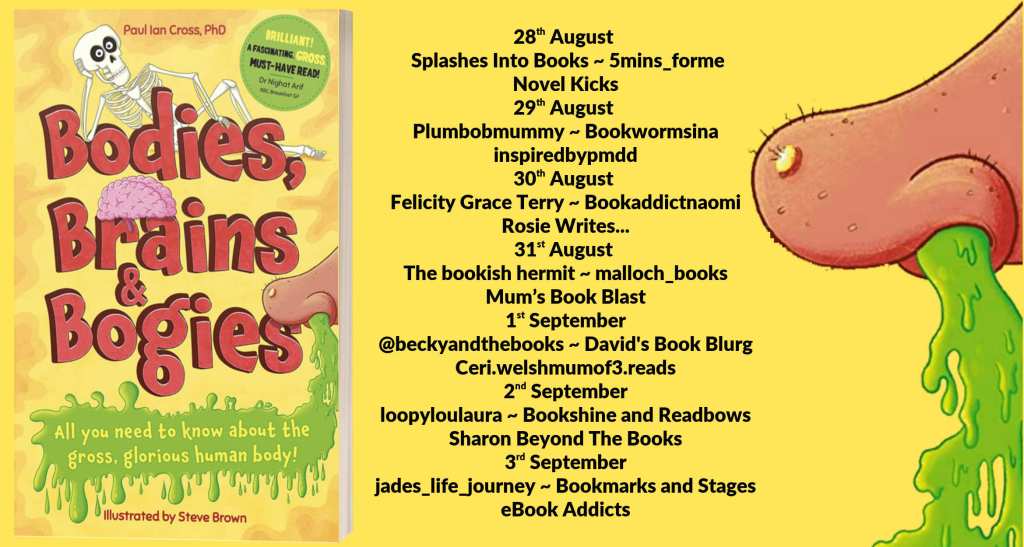
Bodies, brains, and bogies

With a title like Bodies, Brains and Bogies, this could be a new horror movie, but it’s the latest addition to my non-fiction collection. And I’m very excited about it. If your kids like Horrible Histories, they’ll love this. Of course there are other similar books, but given kids devour these books faster than I get through novels on holiday, I reckon you can’t have too many.

There is of course lots of gross stuff in it, perfect for kids to absorb and then spew up at inappropriate times, but there is also a lot of information, presented in a really accessible way. For example, you’ve got to love a BPM chart that starts at zombie level. And I didn’t know that the shape of your nose affects the sound of your voice! But the best bit of all is the section on Body Positivity – what an important topic, and it’s handled so very well – which is then reinforced in the final pages with ‘Six steps to succeed in your skin’.

It wasn’t a surprise to me that the author has outstanding science credentials which, combined with an obvious passion for STEM, and I suspect a sense of humour like a 10 year old, make this book fun, accessible, and informative.

You’ve probably gathered I love this book, but just incase I haven’t shouted out enough, this is an absolute must for every home bookshelf and every school library.

Blurb

This fantastic title from Paul Ian Cross, the writer of How to Vanquish a Virus, takes the reader on a whirlwind tour of everything that’s disgusting, unusual and amazing about the human body. Find out everything about poo, pus and bogies, while learning a whole lot about how our bodies work hard in hundreds of fascinating ways to keep us alive.

With tons of hilarious and informative illustrations, it includes lashings of Paul Ian Cross’s trademark laugh-out-loud humour, in-depth knowledge and infectious optimism. It’s the perfect funny, accessible way to discover everything you’ve ever wanted to know about the human body, but were too grossed-out to ask!

About the author

Author Paul Ian Cross

Paul works in clinical research (developing new medicines) and he’s also a science communicator (presenting science to non-scientists). Paul specialises in vaccine development and has an interest in pharmacovigilance (the safety of medicinal products). His PhD research investigated the benefit-risk assessment of medicines, and how patients and the public can be more involved in their treatment decisions. 

Paul’s popular social media accounts (@DrPaulScience) are full of STEM-themed content for all ages, but particularly for parents and adults to share with the children in their lives. Paul is a member of #TeamHalo, a UN backed initiative where doctors, healthcare workers, and scientists share accurate information about healthcare, science, and the COVID-19 vaccines. In 2021, Paul was named as a ‘Luminary’ at the G7’s Vaccine Confidence Summit, in recognition for his science communication work on social media.

In addition to his research career, Paul has a passion for introducing children to STEM subjects, particularly reluctant readers. By introducing science creatively, he aims to spark their interest, allowing them to gain confidence with their reading. As a previous reluctant reader himself, he understands how hard it can be. But it’s all about making reading fun and interesting! 

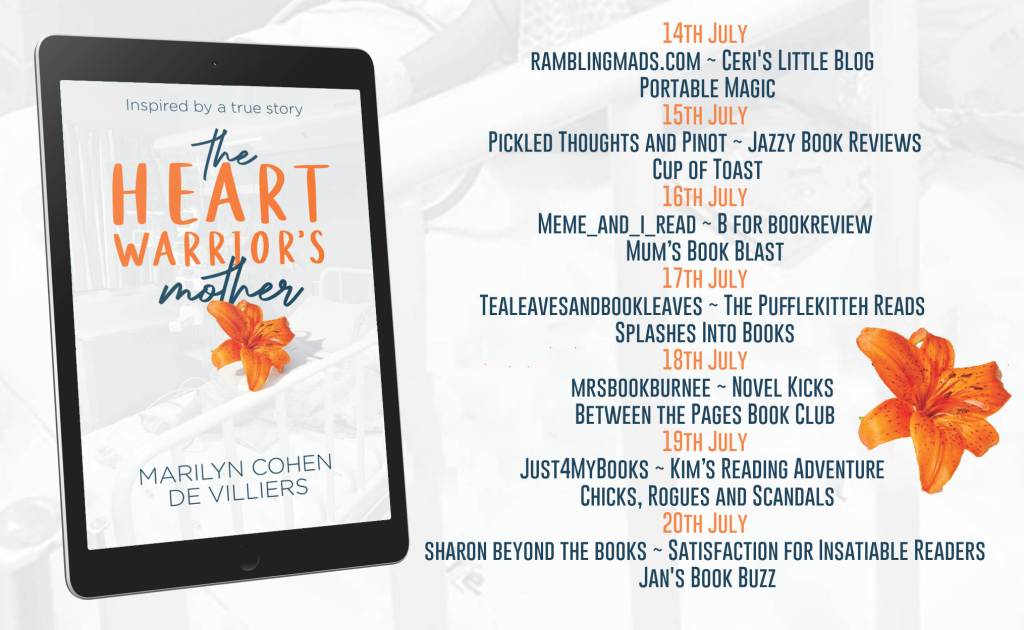
The Heart Warriors ❤️

Generally I review kids books, but every now and then a book covering a topic aimed at parents is too important not to share, and this is one. So please do read my in depth interview on Congenital Heart Disease with the author of The Heart Warrior’s mother. I think you’ll agree.

Did you know that one in 100 children is born with a congenital heart defect? Or that Congenital Heart Disease (CHD) is approximately 60 times more prevalent than childhood cancer and about 25 times more common than cystic fibrosis?

I certainly didn’t – not until I started doing research for The Heart Warrior’s Mother

So why do we hear so little about it? Hopefully, my new book will help to change that.

My journey into the world of heart warriors – children with CHD fighting the odds to survive – when a young man came to my home to buy my late mother’s portable oxygen concentrator which I’d advertised for sale online. I was in the throes of researching a book based on my mother’s experience at the hands of hugely caring medical professionals in the last few months of her life. But when the young man told me about his baby daughter, everything changed. I just knew I had to write this story.

What he told me about his baby, when I met the baby herself – and her incredible mother – it all made me reassess my deepest values about life itself. It made me question my fundamental beliefs about when, in the face of seemingly insurmountable obstacles and a human life seemingly consumed by immense pain and suffering, it is time to say “enough”, to stop medical treatment and let nature take its course. For someone like my mother who had a full and productive life for nearly 90 years, the question (for me, at least) is relatively easy to answer. But when it’s a child – a baby? When there is even the slightest chance that that baby can overcome the obstacles to be well, to be happy, to be grow up… how can parents deny their child that opportunity? But at what cost? How do parents make such decisions?When is it time to simply say “enough”?

I asked the young man and his wife if I could write the story of their little heart warrior. They agreed, hoping that my efforts would help raise awareness of CHD. 

I had intended this to be a non-fiction book. The mother welcomed me into their home and bravely shared herexperiences with me, despite this being terribly painful at time. And I met the little heart warrior herself – and fell in love with her incredible spirit, sparkling eyes and booming laugh. But, unsurprisingly, there were enormous gaps in the mother’s memory of events. Would you remember the doctor’s precise words when he tells you that if your eight-day-old baby doesn’t have immediate open-heart surgery she will die in weeks, if not days? Of course not.

As a journalist, I am passionate about accuracy and authenticity in my writing. If a book is presented as non-fiction, there cannot, for example, be “made up” conversations and dialogues presented in direct speech. There can’t be a fudging of important facts. I’ve never subscribed to the “don’t-let-the-facts-interfere-with-a-good-story” school of journalism. And to me, a non-fiction book is no more or less than another form of journalist. Facts matter. And, the simply truth of the matter was that I didn’t have all the facts. 

If all that sounds incredibly self-righteous, I’m sorry. That’s just the way I am. However, I must also acknowledge that I was wrestling with another problemas well. The mother and father are amazing human beings:  they are hugely supportive of each other, loving, generous, welcoming. In a nutshell (and the mother roared with laughter when I told her this), they are pretty “boring” characters. Where’s the conflict? Where’s the drama that would keep readers enthralled rather than drowning in an unrelenting liturgy of medical procedures?

So – with the parents’ blessing – I swivelled to fictionalising a great deal of the story. The medical aspects are as accurate I could make them, and – except for her changed name – I tried to portray the little heart warrior as accurately as I could. But all the other characters have been changed, as has the story’s timeframe. I’ve also included some totally fictitious events and, of course, introduced several emotionally fraught relationships. I was delighted when the mother said she thoroughly enjoyed reading about her altered persona.

I was also thrilled when Professor Rob Kinsley, a founder member of the World Society of Paediatric and Congenital Heart Surgery and the South African doyen of paediatric cardiac surgery sent me an email after reading The Heart Warrior’s Mother.

He wrote: “As doctors, we tend to overlook the extraordinary stress and hardship families are subjected to when a child is born with a congenital heart defect and embarks on the often long and tortuous road of correction, with an uncertain outcome… This well-written and enjoyable book should be read by every trainee (and trained) paediatric cardiac surgeon, cardiologist, paediatrician and others (to) give them a better understanding of the ‘complete’ picture, rather than simply ‘the patient’.” 

And then he added: “The description of all medical aspects is amazingly accurate.” My journalist heart swelled with pride, gratitude …and relief!

Prof Kinsley also pointed out that most African children with CHD are denied life-saving corrective surgery because of limited state facilities across the continent as well as a desperate lack of funds. He was being generous – most public health facilities in South Africa (and Africa) are horrendous. 

In 2019, Prof Kinsley set up a new organisation, The Children’s Cardiac Foundation of Africa (TCCFA), to “save the lives and improve the health of children born with congenital heart disease in Africa by raising funds for heart surgeries and by training specialists and support staff in the field of paediatric cardiac care”.

To thank and honour my little heart warrior and her parents, I am donating a portion of my royalities from The Heart Warrior’s Mother to the TCCFA. You can also contribute to saving the lives of little heart warriors by donating directly to TCCFA. Details are available on their website https://tccfa.org/

Blurb

Kerry-Anne Aarons is over the moon. She and her husband, Imran Patel, are about to become the parents of a baby daughter, and give their son, Leo, an adored little sister.  It wasn’t planned, but Kerry knows that Lily’s arrival will complete the perfect little family she has always wanted. She, Imran and their two children are going to live happily ever after…

Then life intervenes. 

Lily is born with a serious congenital heart defect and Kerry’s battle to save her daughter commences. It’s a battle that takes her from the operating theatres and Intensive Care Units of local hospitals to the High Court of South Africa. It’s a battle that strains her relationships with her friends, her parents, and – ultimately – her husband.  It’s a battle she is determined to win.

But how much will Kerry have to sacrifice to give Lily the future she deserves?  

A true, cross-generational story of the eternal link between love and pain… the greater the love, the more inevitable the pain. Marilyn Cohen de Villiers once again – with amazing skill – depicts the common humanity that transcends differing cultures.” 

James Mitchell – former Book Editor, The Star, Johannesburg

A  percentage of the proceeds of this novel will be donated to the Children’s Cardiac Foundation of Africa, an organisation that funds lifesaving heart surgery for children across the continent. 

Purchase Links – 

UK – https://www.amazon.co.uk/Heart-Warriors-Mother-Marilyn-Villiers-ebook/dp/B09YV4JDJZ/

US – https://www.amazon.com/Heart-Warriors-Mother-Marilyn-Villiers-ebook/dp/B09YV4JDJZ/

Author Bio

I was born and raised in Johannesburg, South Africa, the youngest daughter of an extraordinarily ordinary, happy, stable, traditional (rather than observant) Jewish family. After matriculating at Northview High School, I went to Rhodes University in Grahamstown where I served on the Student’s Representative Council (SRC), competed (badly) in synchronised swimming and completed a B. Journalism degree. This was followed by a “totally useless” – according to my parents – English Honours degree (first class), also at Rhodes.

With the dawning of the turbulent 1980s, I started my career as a reporter on a daily newspaper, working first in the news and later, the finance departments. During this period, I interviewed, among others, Frank Sinatra, Jeffrey Archer, Eugene Terre’blanche and Desmond Tutu. I caught crocodiles; avoided rocks and tear smoke canisters in various South African townships as protests and unrest against the Apartheid government intensified; stayed awake through interminable city council meetings and criminal and civil court cases – and learned to interpret balance sheets.

I also married my news editor, Poen de Villiers. Despite all the odds against us coming as we did from totally different backgrounds, we remained happily married for 32 years and three days. Poen passed away as a result of diabetes complications on 15 March, 2015.

After the birth of our two daughters, I ‘crossed over’ into Public Relations with its regular hours and predictability. My writing – articles, media releases, opinion and thought leadership pieces and so on – was published regularly in newspapers and other media, usually under someone else’s by-line. I returned to my roots as a journalist in a freelance capacity some six years ago, writing mainly business and IT articles.

So why, after a lifetime of writing non-fiction, did I decide to try my hand at fiction?

The catalyst was the unexpected death of a childhood friend and colleague in 2012. This spurred me to take stock of my life, to think about what I had achieved. A few months later, I decided to try and write a novel. This turned out to be A Beautiful Family which was published in July 2014. The fiction bug had bitten, and my second novel, When Time Fails, was launched in September 2015, followed by  Deceive and Defend, in 2018. Although this was not intended when I first started writing fiction, the three novels together constitute The Silverman Saga trilogy

Unlike my earlier novels, my latest book, The Heart Warrior’s Mother, was inspired by a true story.

Cats, politics, and a mystery

I’m a sucker for a cat, so when I spotted this fabulous cover I had to have a sneak peek at the debut novel. Luckily the author was happy to share an extract (scroll down).

Blurb

Theo Duncan is just an ordinary student. Except he also happens to be the son of the Prime Minister, Will Duncan. When the parliamentary mace is stolen from inside the Houses of Parliament, Theo is determined to help his dad get it back. But he can’t do it alone. And when help is offered, there’s a problem. It comes from the new girl at school, Sammy Jhor, who’s a supporter of the opposition party. 

Theo and Sammy form an unlikely team to spy on government officials, sneak through the corridors of Downing Street and pursue the thief through the Palace of Westminster. But when the evidence points to suspects at the highest levels of government, finding the thief could threaten Will Duncan’s leadership. 

Can Theo and Sammy put aside their differences to find the mace – and the thief – before the government is brought to its knees? 


So here is the extract

When Theo decides to go to the Palace of Westminster to investigate the theft of the mace, he’s surprised to meet Samira Jhor on his way in. Sammy, the new girl at school, was also present during the theft of the mace. Theo knows her as a rule breaker and he isn’t pleased to find her muscling in on the plans he has made for a tour with Rupert Spencer, the government’s Chief Whip.

As Theo approached the entrance to Portcullis House, he heard running behind him.

‘Hey!’ someone shouted behind him.

He turned around to find Samira catching up to him, out of breath.

‘I waved at you from the bus, but you didn’t see me,’ she said between puffs.

‘What are you doing here?’ he said.

‘I could ask you the same.’

Theo fought the heat rising in his cheeks. ‘Working on my Citizenship project.’

‘Me too.’

Theo suspected she was just saying that because he had, but he didn’t dare challenge her. Was she there to investigate the missing mace too? Her mum had thought she would try to get involved and here she was. She didn’t look like she was there for something as serious as investigating a crime or even for school work. She had changed out of her school uniform. The hems of her long black trousers were ripped, the torn ends trailing on the ground. Her long-sleeved black top was pulled down over her hands with holes for her thumbs to poke through, just like her school jumper. A silver chain necklace swung down almost to her stomach. She had scooped her hair into a loose ponytail. A piercing through the top of her ear was now visible, but her red streaks were mostly hidden. She looked like she should be at a gig.

‘Well?’ she said.

‘What?’

‘Come on,’ she replied with an impatient sigh.

The whole wall of the building was glass, with a revolving glass door. Theo caught sight of his reflection in the window and stood up taller. He glanced at Samira as she pushed into the revolving door, wondering how he was going to get rid of her. Without thinking, he followed behind her into the revolving door and they got caught in the same tiny cubicle. Samira scowled at him over her shoulder then pushed on the door. It didn’t move. Theo leant over the top of her and pushed. He was so close that the hair in her ponytail tickled his chin. They scuttled around quickly as the door gave and propelled them forwards.

They stumbled out with a clatter. Samira turned deliberately to glower at him. He shrugged in what he hoped was an apologetic manner.

A security guard waited for them at the end of an airport-style security scanner. They loaded their bags into trays and pushed them on to the conveyor belt towards the scanner.

‘So what are you really up to it?’ Samira asked quietly.

‘Nothing.’

‘If you say so.’

Theo bristled. He was on the point of asking her what she was up to, but she went on ahead, out of whispering range.

As Samira went through a metal detector, Theo searched behind the wall of glass separating them from the main hall. It was a glass-covered piazza. Light from the glass ceiling bathed the people congregated below, their heads bent together, talking intently. It streamed through the trees that lined the middle of the space, creating dappled shadows on the creamy stone floor. It looked like a Mediterranean town square.

Rupert waved at him from the other side – he was on time. Like the last time, he wasn’t wearing a jacket. Theo suspected this was part of his look. It was a ‘man of the people’ look, unlike his dad’s, who was always formal, to suggest leadership and competence.

‘Hi, thanks,’ Theo said as he reached Rupert. ‘This is Samira,’ he said, as she came up behind him.

‘It’s Sammy actually,’ she said.

‘Pleasure,’ Rupert replied. ‘Are you coming on the tour as well?’

‘No,’ Theo said as Samira said, ‘Yes.’

‘I’ve got somewhere to be first. I’m meeting someone.’ She started to hurry away. ‘I’ll catch up with you later.’

Theo watched her with a deep scowl. Who could she possibly be meeting?


The first mystery for me is where does the cat on the cover come into the story? I’m pretty sure it must feature so I reckon any cat loving youngster will lap this up (get it? a cat themed joke – I feel like Basil Brush here – boom boom!) Anyway, I never discuss politics, so I’m going to stay on neutral ground on that point.

About the author

Sarah Lustig grew up in London and went to school in Westminster, with politicians’ children. Her experiences at school and interest in politics inspired the idea for the Westminster Mysteries series. Mystery in the Palace of Westminster is her debut novel. She has been a book editor for nearly 15 years and now lives in Buckinghamshire, where she spends her time reading, writing and pottering on her balcony garden.

Why writing is like coffee.

As you know, I do lots of school visits. And one of the questions I’m often asked (along with the random qs like “What’s your least favourite food?” – it’s custard if you’re curious), is about my writing process from idea generation to finished book. And, like the kids I meet, I’m really nosy about the writing process for other writers. Get a group of authors together and conversation is sure to turn at some point to the big debate: are you a plotter or an pantser. Which is why I read so many writing books. Anyway, today, I have Bonni Goldberg with me, author of The Write Balance: How to Embrace Percolation, Revision & Going Public. So here she is …

I’m especially delighted to be here on Mum’s Book Blast because it speaks to my own identities: I’m a mum, a writer and my debut picture book is coming out in Fall, 2023. I’m even part of a FB group especially for mums who write. I see a lot of overlap between my Mum Self, my Writing Self. Much like being a mum, being a writer is a joy and an endless series of negotiations to achieve balance. And when I say balance here, I don’t mean all at one time, like two sides of a scale. In The Write Balance, it’s about not neglecting time and attention to, or creating a hierarchy from, each aspect of being a writer, especially percolation, revision, and going public.  Percolation is everything that takes place before you put ideas into written words. I know so many writers that judge themselves harshly as “not writing” when they’re percolating. They say, it doesn’t count as writing if I don’t put out words. But with a slight shift in perspective, it becomes clear that there are no written words without percolating first:

(from The Write Balance pp. 14-15)

However you do it, the point of percolation is to let the little cells of the idea gather, divide, and multiply in order to sustain life and energy outside of your thoughts, to coalesce into something that isn’t crushed by written words or blown away by your busy mind. Once the idea has introduced itself, but before you decide to explore it in writing, it needs to take hold and brew in your body and psyche. Something new has stimulated your system. It’s full of the potential to grow into a life separate from you. Like any seed, if the idea is forced into the light of day too soon by impatience or expectations, it shrivels. I’ve lost pieces because I’ve confused inspiration with ripeness, because I was afraid I’d forget the idea if I didn’t get it all down right away, because I made keeping to my writing schedule more important than the writing. It took me a long time to learn that keeping an idea inside for a while helps me to slow down, adjust my expectations, and respect my ideas. 

Edna O’Brien once said, “Writing is like carrying a fetus.” Just as a fetus first grows amphibian-like gills and a tail before it takes its final human form, so a piece of writing first needs to develop into a pre-written state in the world of the psyche. Percolation is the incubation time, but there’s no standard gestation period like nine months for a human baby or twenty-one days for a chick. You can’t predict that it will take six weeks for a short story to grow or twelve minutes for a poem. You might percolate for ten minutes or ten years. One of your Writing Self’s roles is to live with your ideas, get to know them, and intuit when they are ready to see the light of words. 

One way you can tell an idea is growing is that you notice other events or images in the world or in your memory that connect to your maturing idea. When I was living purely with the idea of writing an essay about making borscht, I saw a relationship between me scavenging my fridge for the ingredients and a mouse in my kitchen foraging for crumbs. That connection ultimately affected the tone of my piece.

Back to me.

This is EXACTLY what I say to the kids when they ask me about my process. I let ideas percolate. Actually I use the word “fester”. But given my caffeine addiction, they are probably percolating. I tell them that some ideas fester for ages, for example, I still want to write a story about a lighthouse, but it’s been on my list for about 3 years now. Almost as long as my friend has had “Grout bathroom” on her list.

Anyway, if you’re interested, here is more info on the book.

Blurb

Bonni Goldberg’s The Write Balance introduces you to alternative perspectives and motivation for lasting creative fulfillment. This companion book to the beloved bestseller, Room to Write is filled with encouragement, tools, examples and exercises.

Through years of teaching writing in workshops and in classrooms, Bonni has seen that the writers who are most passionate and grounded in their Writing Self embrace three aspects of the writing process: nurturing ideas, revising to best communicate those ideas, and completing the writing cycle by going public.

In this powerful guide, Bonni invites you to explore these creative stages which are essential to satisfying your Writing Self.

Use The Write Balance to:

  • Find Fulfillment as a Writer
  • Explore Creative Writing
  • Add to Your Writer’s Toolbox for Perspective
  • Overcome Writer’s Block
  • Teach Creative Writing
  • Inspire Your Writing Group
  • Give as Gifts to the Writers in Your Life

About the author

Bonni Goldberg is the author of The Write Balance: How to Embrace Percolation, Revision & Going Public, the companion book to the best-seller Room to Write: Daily Invitations to a Writer’s Life. Bonni is an award-winning poet and writer. She is the creator of the 2 Minute Journals™ series. Both traditionally and indie published, her books include non-fiction for adults and fiction and non-fiction for young readers. Her essays and blog posts can be found in numerous print and online publications.

Bonni teaches creative writing at colleges and leads writing workshops internationally for all ages. She knows everyone is creative, and she supports people to discover and share their authentic, meaningful and imaginative experiences through words. Whether through her writings or through teaching, her methods and perspectives continue to empower thousands of adults, families, and children.

Bonni is also a Jewish educator. She speaks, writes, and leads workshops on Jewish topics such as Jewish identity, rituals and antisemitism at Jewish women’s events, JCCs, and conferences. 

Bonni Goldberg lives in Portland, Oregon with her partner in life, and some creative projects, artist Geo Kendall.