What does an author read on holiday?

I’m always asked by students what my favourite book is, and I always stress I read voraciously and widely, so the answer takes a bit of time, and varies. Having just been asked this question 18 million times in World Book Week, I thought I’d share my last holiday reading pile.

Relaxing reading on holiday image

The Man who Died Twice (Thursday Murder Club #2) by Richard Osman. I just love this series. Am reading them all out of order as I was given a copy of book 3 first. I passed this on to an elderly relative called Joyce (coincidence – how many book characters are there called Joyce?) who lives in a retirement village (double coincidence). I’m pretty sure that copy will do the rounds until it falls apart!

Night Music by JoJo Moyes. This is on audio and the narration is great, but I haven’t finished it yet so no plot spoilers. Listening to it at 1.2x speed. Does anyone else always listen to a slightly faster narration?

Barefoot Britain by Anna McNuff. I’ve heard Anna speak at an Adventure Queens book club event and she’s a bit bonkers which makes for a fun, slightly chaotic trip. I’m officially adopting the phrase “adventure pace” to describe my own sloooow running – it sounds so much more fun than just being ridiculously slow.

Coffee First, Then The World by Jenny Tough. Tough by name, tough by nature. Crikey this woman is impressive! Also an audio book – narrated by Jenny herself which I always find adds an extra connection to the story for me, particularly for non fiction.

Kevin the Vampire by Matt Brown. I’m writing a funny vampire story for kids so this was sort of for research purposes – I wanted to see how “vampiry” chapter books got. I’m not talking blood-sucking monsters, but I wondered if other authors incorporated just a touch of scare. The answer, in this case, is no.

And finally, A Fresh Start at Wagging Tails Dogs’ Home by Sarah Hope. I’m reading this as part of a book tour. I know I normally review kids books, but this is perfect light holiday reading, plus it has dogs, and rescue dogs at that. What more could I want? There is a bit of drama putting the future of the centre in jeopardy and, of course, a romance with a touch of conflict, but for me the absolute stars of the show were the dogs: they were all such big characters, and I felt they were based on real dogs. Then I got to the end of the book and discovered the author’s connection to a rescue centre, so now I’m sure all their back stories are true. Which makes it all the more heartwarming. Then I realised this is Book 3 in a series (it totally stands on its own) so now I’m off to read books 1 and 2. And now I realise I seem to be making a habit out of starting with book 3!
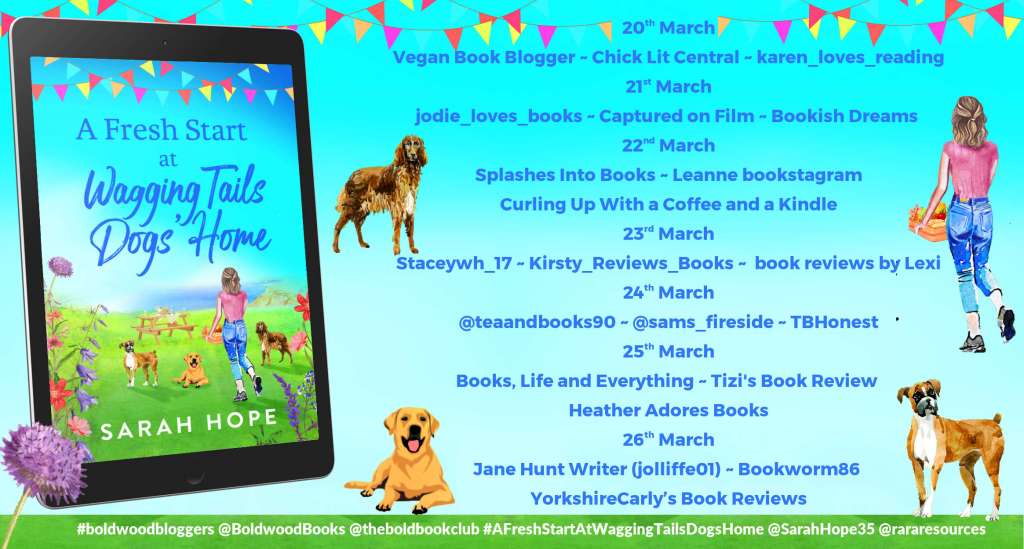
Since this is a tour, I’m going to include a bit more info than the other books above, also, the author is less well known and deserves a bit more recognition!

Blurb

There’s no place like home… Although dog trainer Sally is relatively new to Wagging Tails, the team she works with have quickly become her family and the dogs her friends. But when Andy, the one that got away, turns up for a brief respite from the city, she is at a crossroads. As tempting as a life with him is, she loves her home of West Par, and anyway, she has responsibilities here. Number one on that list is ensuring the dogs’ home stays in business. A developer has been sniffing around wanting to buy the land, and the team is worried. Sally will do anything to save her home and her friends’ livelihoods but the lure of reuniting with her lost love is strong. Is there a way for her to have both?

About the author
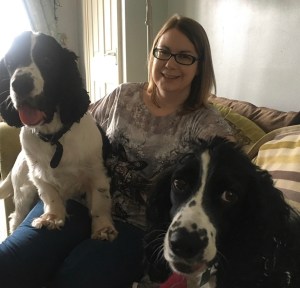
Sarah has been dreaming up stories ever since she was a child. She remembers many a family stroll when she’d daydream up her next story adventure.

As an adult, she prefers to write romance novels and novellas with a Happy Ever After ending. She has two main romance series, the Escape To… series that focuses on single mums taking a chance and fulfilling their career dreams as well as finding love, and The Cornish Bakery series, that follows a busy bakery in a beautiful fictional bay in Cornwall.

Sarah Hope lives in Central England with her two children and an array of pets and enjoys escaping to the seaside at any opportunity.
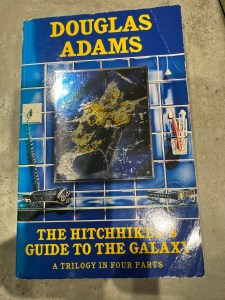
If you’ve ever wished there was a Hitchhikers Guide to the Galaxy book for kids, there is now.

I have a special bookcase for my ‘permanent collection’ – the books I go back to over and over again – and it’s impossible to narrow then down to my absolute favourite (a question I’m asked at every single school visit I do), but for a fun comfort read, I’m going to go with Hitchhikers Guide to the Galaxy by Douglas Adams. I’m sure you know it: “So long, and thanks for all the fish” and the answer is 42 etc; but just incase, in a nutshell, Arthur Dent, in his dressing gown, gets whisked onto a spaceship when Earth is demolished for a hyperspace bypass. Luckily, he has his towel with him.

I vividly recall stumbling across the radio series on my way home from school one day in the 1980s. My dad and I sat in the car outside the house laughing our heads off so it has happy family memories, and it still makes me laugh. I listened to the rest of the series on the radio, then got a copy from the library. My own well-read copy is from 1992.

Lexi's copy of Hitchhikers Guide to the Galaxy

By the way, I also love the 2005 movie version – no book vs. movie arguments from me. It probably won’t surprise anyone, but Red Dwarf is my comfort comedy TV series. I can quote huge chunks from memory. Given this, why I haven’t written a sci-fi comedy is a complete mystery.

Luckily, I don’t have to write one, because Claire Fayers has done it for me. I’m a huge fan of hers and over the past few years have recommended Storm Hound to many young readers. So I was very excited to hear about Tapper Watson and the Quest for the Nemo Machine.

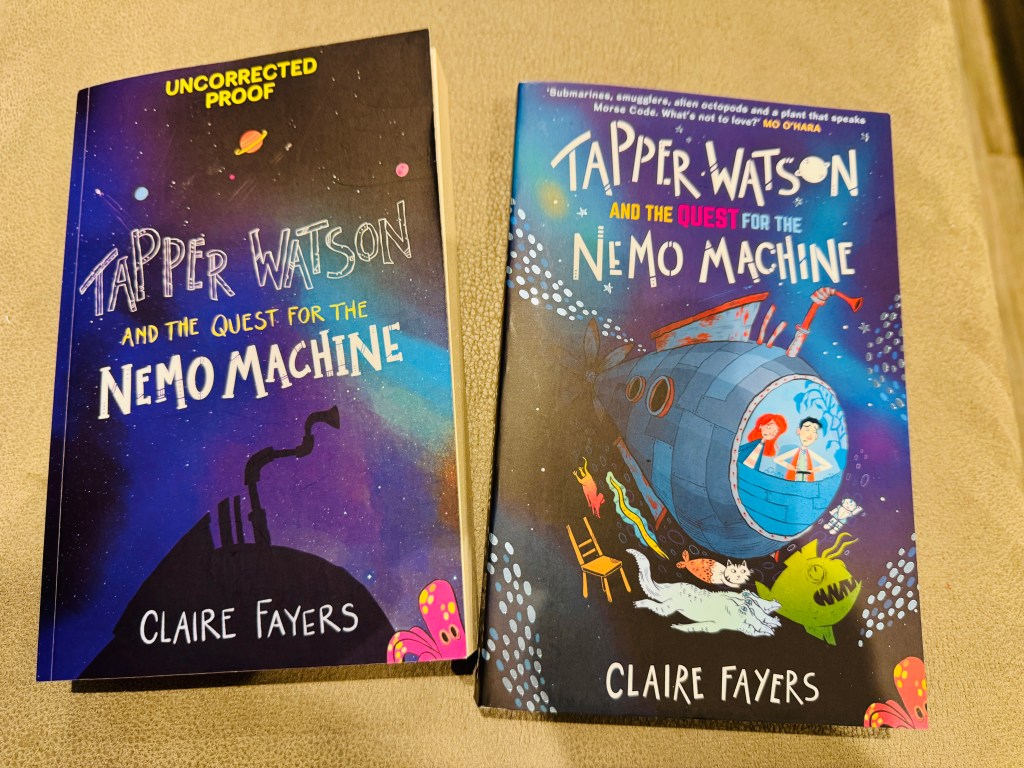
And I was even more honoured to be asked to provide a quote for the cover, and receive a shiny proof copy. If you’ve ever wondered what the difference between a proof copy and a final published book is, this is it. Actually I love the proof cover, but the colour on the final cover really makes it zing.

Photo of a proof copy of Tapper Watson book beside the finished edition.

Anyway, here is what I wrote for the publisher to pick an extract from to use on the cover.

Pack your towel, we’re off on a Hitchhikers Guide to the Galaxy style adventure! As always, Fayers has created a totally unique world, and populated it with a fabulous collection of weird and wacky characters from lobster mobsters to talking plants. It’s fast and funny, with a message on our responsibility for the environment, plus I reckon it’s a great way to start conversations with any young readers trying to understand the devastating impact of dementia.

Lexi Rees review of Tapper Watson

So what did they use? Here it is on the cover!

What do you get when you cross Hitchhikers Guide to the Galaxy with The Northern Lights by Philip Pullman? Tapper Watson. I’m going to put this down for my 2023 book of the year. Enjoy!

Maximising the magic of an author visit

I’ve seen a flurry of posts on various FB groups that I’m in from schools looking for authors to visit for World Book Day (WBD). As an author, it’s our busiest day (or in practice week) of the year. But, like a puppy is not just for Christmas, an author is not just for WBD. We LOVE visiting at any time of the year!

Whilst every school has its own processes for booking and preparing for an author visit, I thought it might be interesting to share a few tips from an author’s perspective on what teachers could do to help the event go smoothly after it has been booked.

Before the Visit

Unless you’ve booked a “big” name (lucky you with the correspondingly big budget!), many of the pupils will likely be unfamiliar with the author. If timetabling permits, some introduction to the the author/ their books can help build excitement. This could take the form of posters around the school, book readings, themed art projects, and classroom discussions. I’ve had students study my website to prepare questions in advance, leading in one case to a discussion on why I hate custard!

Between sessions

We know teachers are frantically busy, but as an author it can be quite daunting to be left to fend for yourself between sessions – it’s a bit like your first day at school: you are completely lost. I’ve had a panic attack about making a cup of coffee in the staff room! Honestly, it’s an absolute minefield – is the coffee communal? Have I picked someone’s special mug? Which milk am I supposed to use?

Outside the staffroom, a classroom assistant or student ambassador to guide the author from classroom to classroom if they are doing a series of events is really helpful. Obviously, check if the author has the necessary Enhanced Disclosure & Barring Service (DBS) approval (in the UK) or equivalent before appointing students to the role.

In your classroom

Please do let the author know if there are any issues within your class that they should be mindful of e.g. pupils where English is a second language, recent family trauma, etc. and be on stand-by to help with any disruptive pupils.

Personally, I like to wrap up any Q&A session with asking a teacher if there is anybody who has had their hand up for a really long time that I’ve missed. Without knowing the pupils, and despite my best efforts, it is easy to miss the quieter child with a half raised hand in a sea of people jumping up and down.

After the Visit

If you do any follow up activities, please do share them with the author! I always try to give positive feedback to pupils who send me stories to read after an event.

Encouraging students to write thank-you notes is not only an exercise in good manners but also a valuable writing exercise, allowing them to reflect on what they learned from the visit. Plus, for the author, receiving personalised messages of appreciation is totally heartwarming!

What would you add to this? Please let me know!

Why writing is like coffee.

As you know, I do lots of school visits. And one of the questions I’m often asked (along with the random qs like “What’s your least favourite food?” – it’s custard if you’re curious), is about my writing process from idea generation to finished book. And, like the kids I meet, I’m really nosy about the writing process for other writers. Get a group of authors together and conversation is sure to turn at some point to the big debate: are you a plotter or an pantser. Which is why I read so many writing books. Anyway, today, I have Bonni Goldberg with me, author of The Write Balance: How to Embrace Percolation, Revision & Going Public. So here she is …

I’m especially delighted to be here on Mum’s Book Blast because it speaks to my own identities: I’m a mum, a writer and my debut picture book is coming out in Fall, 2023. I’m even part of a FB group especially for mums who write. I see a lot of overlap between my Mum Self, my Writing Self. Much like being a mum, being a writer is a joy and an endless series of negotiations to achieve balance. And when I say balance here, I don’t mean all at one time, like two sides of a scale. In The Write Balance, it’s about not neglecting time and attention to, or creating a hierarchy from, each aspect of being a writer, especially percolation, revision, and going public.  Percolation is everything that takes place before you put ideas into written words. I know so many writers that judge themselves harshly as “not writing” when they’re percolating. They say, it doesn’t count as writing if I don’t put out words. But with a slight shift in perspective, it becomes clear that there are no written words without percolating first:

(from The Write Balance pp. 14-15)

However you do it, the point of percolation is to let the little cells of the idea gather, divide, and multiply in order to sustain life and energy outside of your thoughts, to coalesce into something that isn’t crushed by written words or blown away by your busy mind. Once the idea has introduced itself, but before you decide to explore it in writing, it needs to take hold and brew in your body and psyche. Something new has stimulated your system. It’s full of the potential to grow into a life separate from you. Like any seed, if the idea is forced into the light of day too soon by impatience or expectations, it shrivels. I’ve lost pieces because I’ve confused inspiration with ripeness, because I was afraid I’d forget the idea if I didn’t get it all down right away, because I made keeping to my writing schedule more important than the writing. It took me a long time to learn that keeping an idea inside for a while helps me to slow down, adjust my expectations, and respect my ideas. 

Edna O’Brien once said, “Writing is like carrying a fetus.” Just as a fetus first grows amphibian-like gills and a tail before it takes its final human form, so a piece of writing first needs to develop into a pre-written state in the world of the psyche. Percolation is the incubation time, but there’s no standard gestation period like nine months for a human baby or twenty-one days for a chick. You can’t predict that it will take six weeks for a short story to grow or twelve minutes for a poem. You might percolate for ten minutes or ten years. One of your Writing Self’s roles is to live with your ideas, get to know them, and intuit when they are ready to see the light of words. 

One way you can tell an idea is growing is that you notice other events or images in the world or in your memory that connect to your maturing idea. When I was living purely with the idea of writing an essay about making borscht, I saw a relationship between me scavenging my fridge for the ingredients and a mouse in my kitchen foraging for crumbs. That connection ultimately affected the tone of my piece.

Back to me.

This is EXACTLY what I say to the kids when they ask me about my process. I let ideas percolate. Actually I use the word “fester”. But given my caffeine addiction, they are probably percolating. I tell them that some ideas fester for ages, for example, I still want to write a story about a lighthouse, but it’s been on my list for about 3 years now. Almost as long as my friend has had “Grout bathroom” on her list.

Anyway, if you’re interested, here is more info on the book.

Blurb

Bonni Goldberg’s The Write Balance introduces you to alternative perspectives and motivation for lasting creative fulfillment. This companion book to the beloved bestseller, Room to Write is filled with encouragement, tools, examples and exercises.

Through years of teaching writing in workshops and in classrooms, Bonni has seen that the writers who are most passionate and grounded in their Writing Self embrace three aspects of the writing process: nurturing ideas, revising to best communicate those ideas, and completing the writing cycle by going public.

In this powerful guide, Bonni invites you to explore these creative stages which are essential to satisfying your Writing Self.

Use The Write Balance to:

  • Find Fulfillment as a Writer
  • Explore Creative Writing
  • Add to Your Writer’s Toolbox for Perspective
  • Overcome Writer’s Block
  • Teach Creative Writing
  • Inspire Your Writing Group
  • Give as Gifts to the Writers in Your Life

About the author

Bonni Goldberg is the author of The Write Balance: How to Embrace Percolation, Revision & Going Public, the companion book to the best-seller Room to Write: Daily Invitations to a Writer’s Life. Bonni is an award-winning poet and writer. She is the creator of the 2 Minute Journals™ series. Both traditionally and indie published, her books include non-fiction for adults and fiction and non-fiction for young readers. Her essays and blog posts can be found in numerous print and online publications.

Bonni teaches creative writing at colleges and leads writing workshops internationally for all ages. She knows everyone is creative, and she supports people to discover and share their authentic, meaningful and imaginative experiences through words. Whether through her writings or through teaching, her methods and perspectives continue to empower thousands of adults, families, and children.

Bonni is also a Jewish educator. She speaks, writes, and leads workshops on Jewish topics such as Jewish identity, rituals and antisemitism at Jewish women’s events, JCCs, and conferences. 

Bonni Goldberg lives in Portland, Oregon with her partner in life, and some creative projects, artist Geo Kendall.

A modern day pilgrimage

You might have already spotted that this is not a kids book, but every now and then I sneak in a non-fiction book that inspires me as a writer and/or mum.

I love travel books and am going through a phase of reading extreme adventure travel books, but my gentle rambles always feel rather tame by comparison, so I was drawn to an Inner Trek: A Reluctant Pilgrim in the Himalayas and the idea of a businessman with no particular action credentials setting off on a pilgrimage. And as I recently published a kids book on mindfulness (BElieve in YOUrself) and the sequel is out soon, the contemplative aspect also caught my attention. From the blurb, I did wonder if the author might be a bit too introspective or self-absorbed for me, but I shouldn’t have worried. I was totally drawn in to his story from the very start with the “inciting incident” (the writer in me always looks for the trigger for any story, fact or fiction). And I loved the conversations with his wife – it all felt so authentic. It’s different to anything I’ve read before, and well-worth looking at, even if it’s not your usual genre.

Blurb

After being threatened by a Bangalore mob boss, retired Indian businessman in Mohan Ranga Rao makes a vow: if he somehow gets out of the situation, he will thank the gods by going on Kailash Mansarova, a holy mountain pilgrimage in Tibet. What starts out as merely a challenging high-altitude trek soon becomes a life-changing adventure. With a blend of humor, honesty and keen insight, Mohan journeys toward a deeper understanding of the world around him.

A memoir of a road less traveled and a true story of self-discovery at 18,000 feet.

Author Bio

Mohan Ranga Rao is an accomplished businessman, an avid traveller and a generous philanthropist. He has visited over thirty different countries and is drawn to places of natural beauty and physically-challenging trails. Mohan lives in Mysore with his wife Mamatha. They have two adult children. He plays tennis daily, takes frequent hikes and reads anything from scotch labels to quantum physics to Vedanta.